


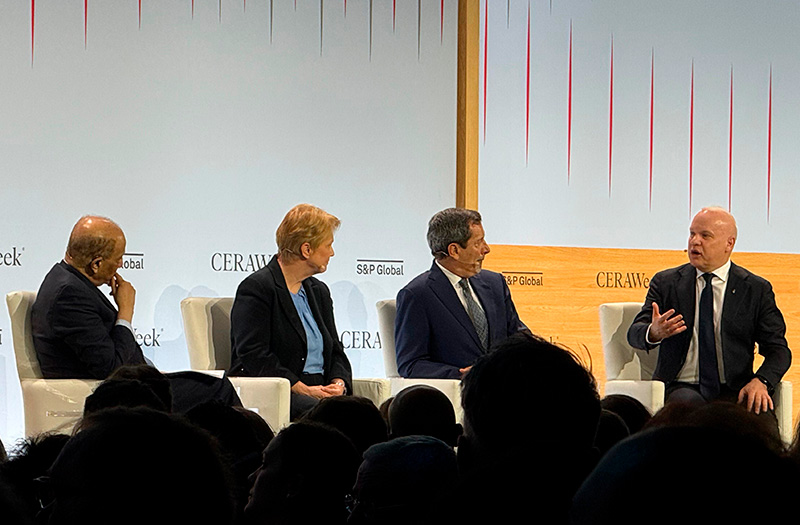
Industry leaders gathered in Houston for CERAWeek 2026 and discussed shifting portfolio strategies. Sustained hydrocarbon demand complicates the energy transition. Technological advancements disrupt traditional business models. Policy volatility forces executives to rethink their investments. Returns on green energy remain highly unpredictable.
Meanwhile, traditional oil and gas projects offer attractive profitability. Resilience requires immense agility. Executives must demonstrate clear foresight. Atul Arya, Senior Vice President at S&P Global Energy, moderated the critical discussion. He emphasized the broad scope of the ongoing changes. “I think what you heard was a fantastic landscape of the world in transition, not energy in transition, but the world in transition,” Arya stated.
The conference highlighted a fundamental industry pivot. Companies prioritize stable returns over rapid green expansion. The transition pace has slowed significantly. Market realities dictate a heavily balanced approach. The world consumes over 100 million barrels of oil daily. Demand shows zero signs of immediate decline. Developing nations require massive amounts of affordable energy.
The Infrastructure Profitability Dilemma
Infrastructure remains a major hurdle for energy companies. Companies cannot view power generation in a vacuum. The supply chain requires seamless integration. Executives emphasize the connection between upstream and midstream investments.
“We don’t want to talk about power isolated from the upstream investment from the midstream investment,” the speakers confirmed. Panelists noted that stakeholders must consider every step. The process spans from generation to final consumption. However, building the necessary infrastructure presents severe financial challenges. Profitability remains notoriously low in this specific sector. “Nobody makes money getting infrastructure right,” the panel argued.
This reality sparks difficult conversations about project funding. “Who’s going to pay for the infrastructure?” the panel asked. Do upstream companies build these massive grid projects? “Is that government role to pay for the infrastructure is a very difficult conversation,” the speakers emphasized. Companies hesitate to fund low-return grid infrastructure projects. The industry needs massive capital for pipelines. Yet, investors demand high financial returns. This disconnect stalls critical development worldwide.
Securing Stability and Government Roles
Government intervention appears entirely necessary to bridge the gap. Panelists drew direct comparisons to other public utilities. “Water and sewage across the world is not the most attractive part of the infrastructure,” the panel explained. Governments typically allocate profits from other sectors. They use these funds to finance basic public needs.
“Government will allocate profits from other parts of the infrastructure,” the speakers detailed. “Can we reallocate profit internally differently?” the panel questioned. Upstream gas operations require significant reassurances. Companies need a rigid government guarantee before committing capital. “You need the reassurance and the guarantee from the government that will be paid for that gas,” executives demanded. Dependence on unreliable government payments creates enormous financial risk. “It’s very difficult for actual upstream players to depend on the government that may not pay this month,” they stated. Such unpredictability completely destroys crucial project economics.
“That doesn’t help at all with economics,” they affirmed. Companies demand profit stability for these massive investments. “So, how do you ensure stability of profits for these companies?” the speakers asked. Policy turbulence severely impacts these massive global investments. “One of the practical problems is if you’re investing in dollars,” they noted. Stable policies attract necessary long-term funding.
Equinor Balances Heritage and Future
Equinor approaches these challenges with a distinct strategy. The Norwegian energy giant recently celebrated a huge milestone. Anders Opedal, Chief Executive Officer of Equinor, outlined the vision. He emphasized the company’s core mission for over two decades. “When we talk about 25 years as a listed company,” Opedal reflected. “So what’s the plan for the next 20 years?” he asked.
“I think we will be guided by our purpose, we are today,” Opedal remarked. He defined this as “energy to people progress to society searching for better.” The company views this constant search as fundamental. “I think this searching for better is the DNA of the company, we have,” Opedal stated. Developing the massive North Sea presented immense challenges. Equinor consistently seeks new technological solutions. The North Sea operations enter a highly advanced chapter. Opedal highlighted the absolute importance of standardizing equipment. He also championed the integration of artificial intelligence.
They are “still embracing new technology like AI and so on to make it better,” he confirmed. This combination makes deepwater operations vastly more efficient. Equinor intends to maintain high production levels. “So sure that we can produce the way to confidence shows as long as high as long as possible,” Opedal said. The company will also continue developing its global assets. They plan on “creating our destiny, our business that we’re combining our knowledge in renewables and natural gas.”
Adjusting the Pace of Green Investments
Equinor acknowledges stark market realities despite its renewable ambitions. The company recently invested heavily in the United States. “We have invested in transportation and storage of CO2,” Opedal noted. However, the energy transition encounters significant delays. “Moving a little bit slower than we anticipated some years ago,” Opedal admitted.
“But in that we will continue to develop oil and gas, but also renewable power,” he added. Equinor adjusted its long-term financial commitments accordingly. The market downturn forced a massive strategic pivot. “Yeah, but much lower than we anticipated because the market went much lower,” Opedal stated. He confirmed that the company drastically reduced capital expenditures. “We reduced the CapEx for 2026 and 2027 by $4 million this year,” he noted. Equinor cut its 2030 renewable capacity target to 12 gigawatts.
The company expects oil and gas production to grow 3% in 2026. Equinor produced 2.14 million barrels of oil equivalent daily in 2025. Traditional hydrocarbons are a key component of the company’s financial foundation. This cash flow funds future low-carbon investments. The pace of development depends entirely on market profitability. Companies refuse to waste capital on unprofitable green ventures. “I think we have to wait until this is over and see what the reality is,” executives cautioned.
SLB Targets Local Specialization
SLB navigates the transition through strategic diversification. Olivier Le Peuch, Chief Executive Officer of SLB, detailed their advantage. He emphasized the absolute necessity of a balanced approach. “I think it’s a balance,” Le Peuch explained. “I think what we would like to do is to be globally diversified and locally specialized,” he declared.
The global landscape evolves rapidly. Every country prioritizes its own energy supply sources. Nations seek to diversify their supply of resources. “Every country is looking after their own supply source, their own diversification of supply,” Le Peuch observed. SLB leverages its massive global footprint completely. “We need to use our global limit to apply locally very specialized and very, very specific technology,” he stated.
The company avoids a broad one-size-fits-all strategy. “We will not necessarily put the same technology in every well,” Le Peuch confirmed. He emphasized, “not necessarily using the same solution in every country.” Carbon solutions must fit specific regional requirements perfectly. “The carbon solutions are fit for certain regions and certain countries,” he explained. SLB identifies the most effective technologies for each basin. This strategy maximizes efficiency and reduces operational costs.
Embracing the Century of Technology
SLB actively expands beyond traditional oilfield services. The company embraces the ongoing artificial intelligence revolution. Le Peuch highlighted SLB’s entry into entirely new sectors. “We are entering into new business such as a data center,” he revealed. This expansion includes massive gas power generation. He mentioned, “including the gas, the gas power generation, and the data construction.”
These new ventures represent a very direct link. SLB recently partnered with major technology firms like NVIDIA. They intend to build an advanced energy data infrastructure globally. The company plans to maintain its dominant global status. SLB envisions a massive operational scale for a century. “Also, a world company under 60 nationalities from the next 100 years,” Le Peuch projected. The company relies heavily on its technological roots.
“We aim to continue to have this DNA, sounds, technology DNA,” he affirmed. SLB believes a specific solution exists for every location. “We believe that there is a solution to every country, to every basin,” Le Peuch stated. “Every resource set will be part of what we need to learn how to be better at scale,” he added. Artificial intelligence currently optimizes complex subsurface analysis.
Occidental Emphasizes Pragmatic Investments
Occidental Petroleum takes a highly pragmatic approach to transition. Vicki Hollub, Chief Executive Officer of Occidental, champions carbon management. Occidental invests heavily in Direct Air Capture technology. The company constructs the massive Stratos facility in Texas. This billion-dollar project extracts carbon dioxide directly from the atmosphere. Occidental plans to capture 500,000 tons of carbon annually.
The company uses this captured carbon for enhanced oil recovery. This process extends the life of existing conventional reservoirs. It also significantly lowers the carbon intensity of produced oil. Hollub consistently emphasizes the importance of utilizing existing infrastructure. This approach entirely avoids enormous capital expenditures. It also accelerates the deployment of critical emission reduction technologies. Occidental balances traditional Permian Basin operations with low-carbon ventures.
The company recognizes the enduring global demand for energy. Occidental uses immense chemical expertise to capture emissions efficiently. They are the largest local manufacturer of potassium hydroxide. These chemical synergies provide a massive competitive advantage. Occidental prioritizes projects that generate immediate financial returns.
Rethinking Capital Allocation
Energy companies ruthlessly scrutinize their capital allocation strategies. The volatile nature of green energy returns demands extreme caution. Executives prioritize projects with swift payback periods. Deepwater drilling and shale production offer highly attractive margins. Companies distribute massive amounts of capital back to eager shareholders.
Equinor plans a huge $1.5 billion share buyback program in 2026. Financial discipline dominates every single corporate earnings call. Companies slash operational expenses to maintain robust balance sheets. They demand strict double-digit returns on all new investments. The slow pace of the transition extends hydrocarbon timelines. Natural gas serves as a critical bridge fuel globally. It provides a reliable baseline power for the expansion of artificial intelligence.
Data centers consume extraordinary amounts of electricity constantly. This massive surge in demand revitalizes gas-fired power generation. The industry adapts quickly to these shifting demand profiles. Capital flows toward the most reliable and profitable opportunities. Energy transition investments must prove their financial viability. Companies no longer subsidize unprofitable green technology projects.
Balancing Security and Sustainability
Energy security completely dominates national political agendas. The XXI century exposed the immense vulnerabilities of supply chains. Wars disrupt crucial hydrocarbon flows across the globe. Nations heavily prioritize domestic energy production. Companies secure long-term contracts to guarantee energy supply. The transition must ensure continuous base-load power. Intermittent renewables cannot support heavy industries alone.
Natural gas provides the absolute necessary reliability. Companies build massive liquefied natural gas export terminals. These huge facilities ensure a steady supply to allied nations. The industry recognizes the dual challenge of security and climate. Executives implement pragmatic emission reduction strategies. They deploy advanced sensors to eliminate dangerous methane leaks.
Companies electrify offshore platforms to reduce operational carbon footprints. These efforts achieve tangible environmental benefits rapidly. They avoid massive economic disruptions simultaneously. The global economy absolutely requires reliable energy. Sustainability initiatives cannot compromise basic energy security. The industry constantly navigates these competing pressures.
The Path Forward for Energy
The energy sector stands at a critical historical crossroads. The XXI century requires unprecedented innovation and massive scale. Companies must navigate immense geopolitical turbulence and unpredictable policies. They must deliver reliable energy to a growing global population. The CERAWeek 2026 discussions highlighted this monumental task. Leaders like Opedal, Hollub, and Le Peuch embrace pragmatic strategies.
They refuse to abandon highly profitable core businesses prematurely. Simultaneously, they invest strategically in future technologies. Artificial intelligence will deeply redefine operational efficiency. Carbon capture projects will mitigate unavoidable industrial emissions. Infrastructure development requires new cooperative funding models. The world in transition demands realistic timelines and massive capital.
Energy companies possess the necessary immense engineering expertise. They also control the massive balance sheets required. Success depends on extreme agility and relentless focus. The industry will absolutely evolve over time. However, hydrocarbons will remain foundational for decades. “And it’s only at Sera week that we can talk about CO2,” Arya concluded.
More news: Supply Security and Infrastructure
More: CERAWeek
