


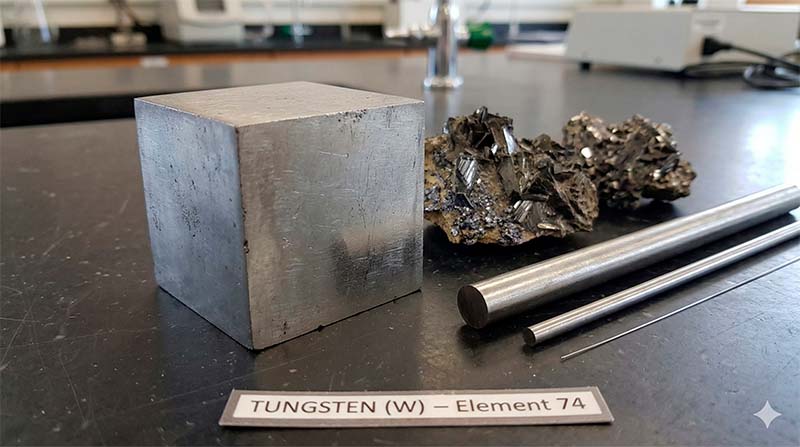
From the analytical vantage point of Wall Street and the strategic corridors of the Pentagon, the macroeconomic landscape of the current decade has entirely shattered traditional valuation models. Historically, during periods of acute geopolitical friction, institutional capital predictably fled toward the immutable safe haven of gold.
Tungsten Skyrockets 557% as the New Recession-Proof Hedge
However, as we analyze market data well into 2026, we are witnessing an unprecedented structural realignment. Gold, while strictly maintaining its monetary prestige and acting as a hedge against fiat debasement, has been vastly eclipsed in sheer performance by a dark, incredibly dense, and thermodynamically extreme metal: tungsten. This distinct element has definitively transitioned from a mere industrial input to an irreplaceable cornerstone of national sovereignty. This monumental shift is currently being driven by a severe contraction in Asian supply, highly inelastic military demand, and profoundly disruptive environmental regulations reshaping the munitions landscape.
The Physics of Lethality and Terminal Ballistics
To comprehensively understand the massive financial premium that global markets are now assigning to tungsten, it is absolutely imperative to dissect its technical irreplaceability on the modern battlefield. The defense industry does not procure tungsten due to arbitrary corporate preferences or cost-efficiency paradigms; it procures it because fundamental physics offers zero viable alternatives. Boasting a density that oscillates between 17.0 and 18.8 g/cm³ in its specifically alloyed forms—overwhelmingly surpassing the 11.3 g/cm³ of lead and more than doubling the density of standard steel—and a staggering melting point of 3,422 °C, tungsten stands out as the ultimate vector for kinetic energy delivery.
In the highly specialized realm of contemporary terminal ballistics, Tungsten Heavy Alloys (synthesized meticulously via powder metallurgy with complex binder matrices composed of nickel, iron, or copper) and tungsten carbide completely dominate the manufacturing of armor-piercing munitions. Long gone are the days of solid steel projectiles or the politically toxic and environmentally hazardous depleted uranium penetrators.
During a hypersonic impact against modern composite tank armor, a tungsten penetrator generates highly localized adiabatic shear bands. It flows hydrodynamically through the microscopic fissures in the enemy armor, causing catastrophic structural failure with ruthless efficiency. Tungsten carbide, consistently registering a Vickers hardness of 1200 to 1500 HV compared to the mere 600 to 800 HV of hardened steel, remains practically immune to plastic deformation upon impact.
Power Ball
This undeniable ballistic supremacy has now been miniaturized for infantry operations. Elite manufacturers have recently introduced tungsten carbide penetrators for standard assault rifles, perfectly exemplified by the revolutionary “Power Ball” core developed by Nammo in the 5.56 mm caliber. Weighing a mere 1.1 grams, these hyper-dense cores increase lethal armor penetration by an astonishing 58%, effectively engaging hardened targets at 900 meters compared to the 570 meters of standard-issue ammunition, and delivering a residual kinetic energy that is 36% higher at a 500-meter range.
Simultaneously, sophisticated tungsten superalloys remain critical for the precise manufacturing of aerospace turbine blades and highly calibrated inertial counterweights in guided missile systems, decisively driving current estimates that the global military consumption of the metal will grow by a robust 12% throughout 2026.
The Green Revolution and Environmental Regulation
Moving far beyond the classified budgets of the Pentagon, a second, equally powerful vector of demand—regulatory in nature—is rapidly suffocating global inventories. The mandated transition toward “green ammunition” has been driven by the European Union’s expansive REACH legislative framework. Repeatedly citing the chronic poisoning of fragile ecosystems and wetland habitats, the European Commission has aggressively initiated the progressive ban on lead, establishing exceedingly strict deadlines to completely eliminate lead hunting shot within a narrow window of three to five years. This unprecedented regulatory sweep aims to proactively mitigate the toxic dispersion of an estimated 558,000 projected metric tons of lead over the next two decades.
Faced with this outright prohibition, the civilian and law enforcement industries initially experimented with steel and bismuth alternatives. However, the unforgiving laws of aerodynamic thermodynamics quickly exposed their fatal ballistic flaws: highly erratic shot dispersion and a severe lack of kinetic energy retention downrange. Tungsten immediately emerged as the only scientifically superior alternative. A significantly smaller diameter tungsten pellet carries exponentially more terminal energy than a much larger caliber lead pellet, effectively allowing for unsurpassed pattern densities and lethal impact at highly extended ranges.
This irrefutable technical superiority has aggressively incubated an “ultra-premium” civilian ammunition market, which is now conservatively projected to reach between 210 million and 380 million dollars in 2026, displaying a robust Compound Annual Growth Rate oscillating between 5.5% and 7.2%. In the broader macroeconomic picture, the entire ammunition market projects dizzying expansions, with the most aggressive institutional analyses forecasting a staggering global value of 66.06 billion dollars by 2031, heavily sustained by a relentless annual growth rate of 13.7%.
Financial Divergence: The Ascent against the Gold Standard
The raw behavioral mechanics of the commodities market between 2025 and 2026 have effectively rewritten modern financial textbooks. During this highly volatile period, gold executed an undeniably extraordinary bullish rally. Powerfully driven by massive institutional purchases—such as the unprecedented 980 metric tons absorbed by central banks in the third quarter of 2025 alone—and consecutive interest rate cuts, the precious metal decisively broke the barrier of 5,019 dollars per troy ounce in March 2026. This represented a phenomenal year-over-year growth of 51.25%, firmly solidifying its traditional role as the ultimate hedge against fiat inflation.
However, tungsten completely pulverized those conventional metrics. Traded primarily in Metric Ton Units (MTU) as the chemical intermediate Ammonium Paratungstate (APT), the market experienced a truly hyperbolic shock. In early 2023, the raw material traded at a relatively modest average of 312 dollars per MTU. Fast forward to March 2026, and top-tier price intelligence platforms reported average spot transactions of 2,250 dollars per MTU in Europe, featuring isolated panic-buying peaks reaching up to 2,400 dollars. This massive, unprecedented 557% revaluation was not the byproduct of irrational retail speculation; rather, it was the direct manifestation of an existential crisis within the global supply chain.
Metal of Geopolitical Survival
Unlike gold, tungsten does not function as a passive store of value; it is fundamentally a metal of geopolitical survival. The demand for critical ballistic and aerospace components is perfectly inelastic. As leading commodity strategists routinely point out, price spikes do not destroy demand in the defense sector; a multi-million-dollar hypersonic missile simply does not admit cheap metallurgical substitutes without severely risking total mission failure. Consequently, tungsten has uniquely positioned itself as a completely recession-proof hedge, largely immune to the erratic fluctuations of fiat currencies and anchored directly to the absolutely unbreakable budgets of national security.
Asian Hegemony and Supply Strangulation
The undeniable primary catalyst for this explosive price action lies directly within the highly asymmetrical architecture of the global supply chain, which has been monolithically dominated by the People’s Republic of China. Skillfully leveraging aggressive state subsidies throughout the XX century and the early XXI century, China meticulously executed a devastating market-dumping strategy that effectively eradicated independent mining operations across the West. This protracted economic warfare ultimately forced the total cessation of commercial primary tungsten mining in the United States by 2015.
According to the most recent geological intelligence data, China firmly controls a staggering 79% of global extraction (approximately 67,000 metric tons in 2024) and completely monopolizes 85% of the crucial global chemical processing capacity required to produce the refined APT intermediate. In February 2025, strategically citing the deteriorating ore purity of its aging domestic deposits and operating clearly within a broader geopolitical tactical framework, Beijing suddenly imposed draconian export controls. The commodity intelligence firm Project Blue reported an alarming 40% decline in physical shipments from China to the West throughout 2025, effectively paralyzing major European and American defense contractors.
Legislative Countermeasures and the Pentagon’s Doctrine
This glaring strategic vulnerability aggressively forced Washington to weaponize its massive procurement capabilities. Through the strict provisions of the National Defense Authorization Act for the upcoming fiscal years, and rigorously regulated under the strict 10 U.S.C. § 4872 statute alongside targeted DFARS clauses, the Pentagon has imposed a completely non-negotiable mandate. Effective January 1, 2027, the Department of Defense is strictly prohibited from acquiring any military component, raw powder, or specialized alloy containing tungsten that was extracted or processed in countries designated as foreign entities of concern, prominently including China and Russia.
To further intensify this economic isolation, the United States actively invoked Section 301, levying punishing 25% tariffs on all Chinese imports of tungsten derivatives. This calculated legislative pincer movement has rapidly transferred trillions of dollars in future financial incentives directly toward any corporate entity capable of securely supplying “conflict-free” material. This paradigm shift has fundamentally altered all institutional financial projections, which now boldly estimate that the fully integrated tungsten market will exponentially jump from 5.26 billion dollars to well over 11.25 billion dollars by 2035, displaying a sustained compound annual growth rate vastly exceeding 8.14%.
Corporate Resurgence and the Mining Map
This ongoing logistical cataclysm has forcefully redirected institutional capital flowing from Wall Street, actively diverting it away from passive physical gold ETFs and channeling it directly toward a highly select group of small and mid-cap Western mining corporations that now inherently possess disproportionate strategic weight.
Standing at the absolute vanguard of this industrial resurrection is the highly aggressive Canadian firm Almonty Industries. Its market capitalization violently exploded, surpassing the 4.75 billion dollar mark in mid-2026, directly following the highly successful commissioning of Phase 1 of the legendary Sangdong mine located in South Korea. This colossal, historically significant underground project, fully revitalized with well over 100 million dollars in targeted investment capital, boasts a phenomenal ore grade of 0.51% (effectively tripling the global industry average).
Korean Trinity
Executing its highly touted “Korean Trinity” strategy—which seamlessly integrates the raw mine with a state-of-the-art biochemical processing plant to entirely bypass Chinese chemical refining—Almonty heavily projects to process an astounding 1.2 million tons of rock in its upcoming Phase 2. This promises to single-handedly supply nearly 40% of the entire Western market’s massive structural demand starting in 2027.
Running in parallel with these historic profit margins, specialized Australian operators such as EQ Resources have skillfully leveraged them. Actively operating the high-yield Mt Carbine mine and successfully accessing ultra-high-purity quartz veins, the company proudly reported a massive 33% quarter-over-quarter increase in extractive growth in early 2026. This operational success rapidly transformed its gross revenues, pushing them to a robust 44 million Australian dollars.
On the domestic North American front, highly agile junior companies like Spartan Metals, operating in Nevada, and GoldHaven Resources, aggressively exploring in British Columbia, are rapidly consolidating vast hectares of mineral-rich land under highly favorable, fast-tracked government policies. They are meticulously preparing to feed their extracted resources directly into the voracious machinery of the Department of Defense.
The Kinetic Horizon
The incredibly complex tungsten market has decisively transcended all forms of traditional cyclical financial analysis. The unprecedented 557% explosion in its overall valuation is the ultimate, undeniable symptom of a world deeply entrenched in a rapid process of geopolitical fracture and massive global rearmament. While gold will undoubtedly continue its historic role of protecting conservative portfolios against the ongoing degradation of fiat currency, tungsten has officially crowned itself as the ultimate underlying physical asset that directly protects the sovereign integrity of nations.
With the rapidly approaching regulatory guillotine of the 2027 federal mandate, the relentless flow of physical lethality demanded by ongoing contemporary conflicts, and the massive influx of corporate capital injected to urgently rebuild Western industrial infrastructure, Element 74 has undisputedly consolidated its position. It stands today as the single most critical, highly strategic, and financially valued commodity of the entire XXI century.
More news: Energy & Commerce
More news: Marvel Microreactor Testing
