


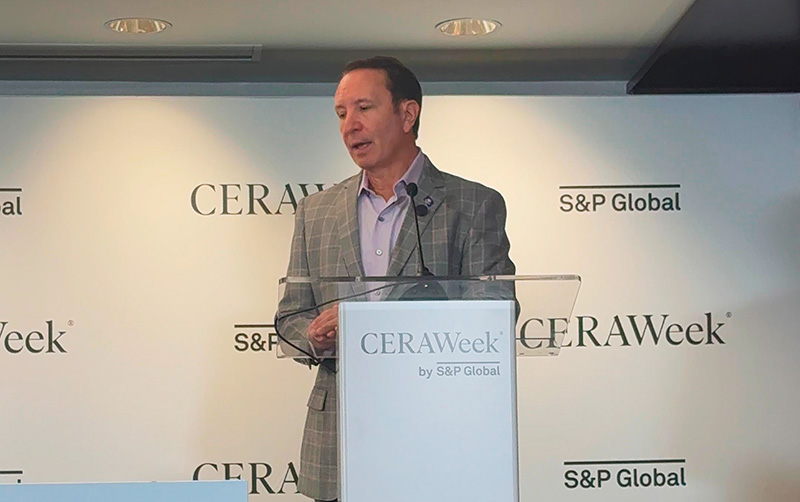
At CERAWeek 2026, global energy security dominated the entire event agenda. The United States currently holds the top position as the world’s largest liquefied natural gas supplier. Facilities exported over 86 million metric tons of the product last year. Geopolitical shocks have repeatedly disrupted traditional supply chains over the past decade. American energy exports helped stabilize fragile international markets. European nations relied heavily on American fuel to survive recent winters. For those reasons, Louisiana serves as the Global Hub for Energy and LNG Exports.
Louisiana plays a remarkably central role in this ongoing global strategy. State officials actively align local infrastructure projects with massive global demand. Louisiana Governor Jeff Landry addressed the conference attendees directly. He detailed his administration’s plan to maintain the state’s dominant leadership position. The governor emphasized sweeping regulatory reform. He pointed to public safety improvements and robust education initiatives as primary drivers for business investment.
State authorities want to completely reorganize complex bureaucratic structures. Past administrative hurdles previously stifled heavy capital deployment in the southern region. Now, leaders promise a streamlined and efficient approach. The energy market requires extreme agility and massive infrastructure. Louisiana officials firmly believe the state possesses both elements in abundance.
Managing the Carbon Capture Surge
Industrial manufacturers face intense and increasing pressure to lower carbon emissions. International buyers frequently demand a blue tag on imported physical products. This specific tag officially certifies significantly lower carbon footprints. Carbon capture and sequestration provides a highly viable path for companies to meet these stringent standards. Louisiana recently secured regulatory primacy over carbon capture wells from federal authorities.
This coveted federal authorization sparked a massive influx of new permit applications. The sudden surge created significant administrative challenges for local state regulators. Governor Landry implemented a temporary pause on new carbon capture permits last year. He defended this strategic decision strongly during the energy conference. The governor explained that the state received a completely disproportionate share of applications. Officials desperately needed time to establish a safe and orderly review process.
“We want to make sure that this technology and this process are done safely and effectively and protect the environment,” Landry stated. The administration currently aims to process existing applications methodically. “Look, we are going to deal with the permits that are in place right now in the order that they came in,” Landry confirmed. The state prioritizes safety over speed.
Unmatched Infrastructure Provides an Edge
Other states aggressively compete for lucrative energy investments and corporate relocations. However, Landry dismissed the idea of direct competition from neighboring regions. He argued that Louisiana possesses entirely unique and unmatched structural advantages. The state is home to the nation’s only offshore oil and gas port. Louisiana also boasts more miles of pipeline than any other American state.
Major and extensive railway networks connect directly to the bustling port of New Orleans. Deepwater ports line the southern coast strategically. This extensive logistical network handles massive volumes of energy products daily. “We have the infrastructure that has been waiting for an opportunity for an economy like what we see in the future,” Landry noted. The governor claimed that past state setbacks stemmed entirely from self-inflicted bureaucratic delays. State agencies currently work to eliminate these internal barriers quickly. The state government actively seeks to treat private capital well.
Officials push comprehensive tax reform and strict public safety measures to attract large corporations. Infrastructure provides the necessary physical foundation for heavy industrial growth. When reporters asked the governor to rank his state against direct competitors, he placed Louisiana firmly at number one.
Pushing the Boundaries of Natural Gas
Industry analysts frequently raise questions surrounding the longevity of the Haynesville Shale formation. Some energy extraction companies recently shifted their active operations into East Texas. Market observers question exactly how long Louisiana can sustain high levels of gas production. Landry responded to these concerns with important historical context. Energy experts incorrectly predicted peak oil and gas in the late 20th century.
At that time, energy companies planned to import large quantities of foreign natural gas. Technological advancements completely reversed that expected trajectory. The shale revolution transformed the United States into an absolute export powerhouse. Drillers continuously find innovative ways to extract more resources from previously inaccessible areas. Landry cited a recent major project located in Lower St. Martin Parish. A dedicated drilling team there recently reached an astonishing depth of 31,000 feet.
This impressive achievement officially broke the state record for the deepest gas well. The governor expressed genuine enthusiasm for energy discoveries located in other states. He noted that existing pipelines ultimately carry production from Texas or Utah directly to Louisiana export terminals. Louisiana’s infrastructure guarantees its total dominance in the export sector regardless of the extraction site.
Powering the Artificial Intelligence Boom
Technology companies require massive amounts of reliable electricity to power artificial intelligence. Massive data centers are popping up rapidly across the entire country. These large facilities often draw intense concern from local communities regarding power grid strain. Louisiana recently secured a major and lucrative data center project with Meta. Landry praised the successful negotiation process between the state and the technology giant.
Both sides clearly communicated their operational needs and limitations. The governor firmly believes that data centers can absolutely coexist with low energy costs for consumers. Louisiana currently ranks 25th in total population but 13th in overall electrical production. State leaders are eager to further expand power generation capacity. Landry sharply criticized restrictive energy policies implemented in the Northeastern states.
He blamed high electrical bills there on strict pipeline restrictions and aggressive green energy mandates. He stated that the United States must completely double its electrical capacity within 10 to 15 years. The governor argued that heavy reliance on solar and wind energy directly inhibits efficient capacity expansion. The state plans to aggressively support more pipelines and drilling to safely meet future electricity demand.
Expanding Strategic International Influence
Louisiana reaches far beyond traditional state borders to secure vital energy partnerships. Governor Landry currently serves actively as a special envoy to Greenland. He travels to Washington frequently to brief federal officials on this unique initiative. The governor views this diplomatic role as a significantly strategic opportunity for his state. He emphasized the rapidly growing strategic importance of Greenland to core American interests.
The United States desperately needs a much stronger physical presence in the Arctic region. Landry focuses heavily on initiatives that benefit both native Greenlanders and American citizens simultaneously. International companies also play a remarkably major role in the local Louisiana economy. State officials actively welcome substantial foreign investment from friendly, non-adversarial nations. Japanese companies maintain significant and profitable upstream investments across Louisiana.
A South Korean manufacturing firm recently funded a massive brand-new steel mill. Woodside Energy, a prominent Australian company, announced a historically massive investment in a local liquefied natural gas facility. State authorities closely coordinate operational logistics with these international partners. This deep global integration greatly strengthens the local economic foundation and supports long-term commercial growth.
Building a Resilient Modern Workforce
The rapid rise of artificial intelligence creates deep uncertainty in the modern labor market. Many active workers fear that sudden automation will completely eliminate their livelihoods. Governor Landry acknowledged artificial intelligence as a truly major market disruptor today. However, he compared this current shift directly to previous massive technological revolutions, like the rise of the internet.
The state government focuses heavily on preparing young workers for the rapidly changing global economy. The governor highlighted a highly critical statistic regarding modern industrial employment. Approximately 70% of currently available jobs do not require a traditional four-year college degree. Many of these specialized vocational positions pay significantly more than roles requiring only a basic university education. Artificial intelligence simply cannot perform heavy physical labor or complex skilled trades.
Advanced machines cannot physically extract crude oil from deep underground. Complex software programs cannot weld steel pipelines or run critical electrical wiring safely. The state education system is pivoting rapidly to meet this highly specific industrial demand. Louisiana aggressively aims to build a highly skilled workforce tailored entirely to physical industrial needs. Leaders plan to match human resources directly with the heavy physical requirements of the energy sector.
Preparing for the Next Decade
Global energy demand will continue to rise throughout the 21st century. Experts predict a steady increase in international fuel consumption. Natural gas will undoubtedly play a crucial transitional role. Louisiana is perfectly positioned to capitalize on this global trend. The state government consistently removes bureaucratic obstacles to accelerate development.
Leaders recognize the urgent need for rapid infrastructure expansion. Deep-water ports and extensive pipeline networks provide a significant competitive advantage. Governor Landry remains highly optimistic about the future of his state. He envisions a booming economy driven by massive energy exports. The administration fully commits to supporting both traditional drilling and modern data centers. Educational institutions will supply the necessary skilled labor to power these massive industries.
The United States needs reliable energy partners to maintain global stability. Louisiana stands completely ready to meet that massive international responsibility. The state will fuel the world and build a prosperous local economy simultaneously.
More news: Eni Redefines Energy Strategy Through Supercomputing and Satellite Spinoffs
More: CERAWeek
