


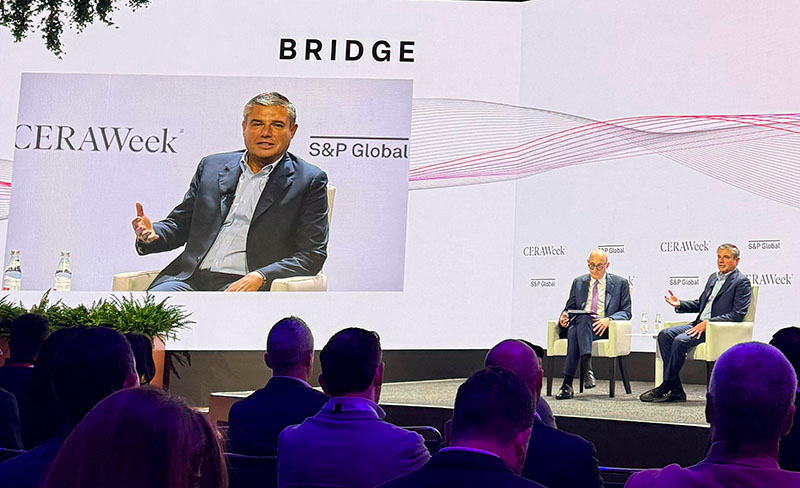
Global markets face constant, unpredictable volatility today. Regulatory environments grow more complex every single year. The aggressive push toward a low-carbon future forces corporate leaders to rethink their strategic visions completely. This rewrites the energy equation in the AI Era.
Navigating Volatility and Regulatory Complexity
Executives must translate long-term planning into sustained competitiveness. Business leaders continually refine their core models to adapt to profound market uncertainty. They respond quickly to rapidly evolving policy conditions. Recent supply chain disruptions highlight the desperate need for proactive corporate leadership. Companies balance near-term performance with long-term digital transformation daily.
Lorenzo Simonelli
Chairman & Chief Executive Officer, Baker Hughes
Lorenzo Simonelli, Chairman and Chief Executive Officer of Baker Hughes, addressed these massive global challenges directly at CERAWeek 2026. Simonelli shared critical insights from his extensive executive tenure. He detailed how his company navigates intense regulatory complexity successfully and explained how the organization manages unprecedented energy transition pressures.
He emphasized that business strategy requires continuous, deliberate evolution. “The first thing I’d say about strategy is it’s not just one point in time,” Simonelli stated. “It’s very much an evolution that gets created over time.”
Restructuring the Corporate Architecture
Corporate evolution often demands painful, comprehensive organizational restructuring. Baker Hughes experienced significant operational changes over the past decade. The organization originally emerged from a massive industry merger. A large multinational conglomerate previously owned the entire company. That parent corporation eventually decided to sell the business entirely. Simonelli described this turbulent period as a corporate roller coaster.
Leadership recognized the urgent need for a coherent operational structure. They evaluated the massive company portfolio very carefully. The executives realized their core corporate strength involved managing chemical elements. Simonelli called this fundamental concept ” helping the molecule flow.” This complex process involves safely extracting natural resources from the earth.
It includes moving those volatile resources securely across vast geographical distances. Finally, the process creates useful end products for commercial power generation or petrochemical refineries. The company launched a strategic operational phase called Horizon 1. This crucial phase covered the fiscal years from 2022 to 2025. Leadership divided the massive business into two distinct main segments.
They created the Oilfield Services and Equipment division. They also formed the Industrial Energy Technology division. “Look, the first thing we have to do is coherently get ourselves into an architecture that makes sense,” Simonelli explained. This new modern architecture allowed the company to focus intensely on operational excellence.
Mastering the Subsurface and Surface Environments
The dual-segment structure clarifies the overarching corporate mission clearly. The Oilfield Services and Equipment segment focuses entirely on resource extraction. It leverages deep scientific knowledge of the complex subsurface environment. Geologists analyze intricate reservoir dynamics to maximize the final hydrocarbon payload recovery.
Engineers extract valuable hydrocarbon molecules from deep underground rock formations. They also manage innovative carbon capture projects by safely storing CO2 molecules. Some specialized engineering teams develop highly secure underground gas storage solutions. These vital extraction insights directly inform all subsequent surface operations.
Once field workers extract the molecule, the second segment takes total control. The Industrial Energy Technology division processes the raw extracted resource. The extracted molecules must provide a tangible industrial outcome eventually. Baker Hughes manufactures the necessary topside heavy equipment for this processing phase. The company produces massive industrial compressors, specialized valves, and advanced gas turbines.
Specialized manufacturing facilities build extremely large liquefaction trains. Modern factories also manufacture heavy-duty electric motors and large power generators. These powerful industrial machines transport the valuable molecules globally. They also actively convert the raw materials into usable consumer energy. Simonelli highlighted the critical synergy between these two distinct corporate segments.
“At the end of the day, you are in the same value chain,” he noted. Customers purchase integrated hardware solutions that span both sides of the business. This streamlined corporate structure dramatically reduces internal operational confusion. It drives massive operational efficiency across the entire global company portfolio.
Feeding the Exponential Data Center Revolution
The XXI century digital economy demands massive, uninterrupted computing power globally. Artificial intelligence requires truly enormous electrical resources to function properly. Technology companies build massive hyperscale data centers all over the world. These enormous facilities consume unprecedented amounts of daily electrical energy.
Data centers currently consume roughly 2% of total global electricity. Industry analysts predict this massive figure could rise by 50% very quickly. Baker Hughes firmly positions itself to serve this booming global technology market. The company provides essential power generation equipment for these massive hyperscalers.
Simonelli identified distributed power generation as a massive corporate growth theme. Technology firms desperately want independent, highly reliable power sources. They actively seek off-grid hardware solutions that operate securely behind the meter. Baker Hughes manufactures advanced industrial gas turbines for these exact technological applications. Corporate technology customers also demand significantly lower carbon emissions from their power sources.
The industrial company develops tailored, clean energy solutions to meet these strict environmental criteria. “Today, we’ve substantially increased our order intake across the hyperscalers, and we see that continuing,” Simonelli confirmed. The executive team also aggressively targets the rapidly expanding data cooling sector. Massive data centers generate incredibly intense physical heat constantly.
Effective advanced cooling systems ensure continuous, safe computer server operations. The company intends to acquire specialized liquid cooling technology to complement its energy offerings. This aggressive expansion strategy creates a comprehensive, highly attractive package for major technology firms.
Deploying Artificial Intelligence for Internal Engineering
Energy companies do not just supply raw electrical power to artificial intelligence firms. They actively integrate generative artificial intelligence into their own daily corporate operations. Simonelli calls this new software technology a fundamental, incredible game changer.
Engineers use advanced machine learning algorithms to accelerate new product introductions safely. Artificial intelligence runs incredibly complex physical engineering simulations extremely quickly. Software digital agents test countless operational design variables in mere seconds. This powerful digital capability creates vastly superior mechanical engineering outcomes.
Simonelli praised the remarkable operational accuracy of these new digital systems. He noted they create robust engineering solutions that are “99.9% foolproof.” The new generative technology dramatically increases basic mechanical component design speed. It rapidly streamlines the complex material requisition process across global supply departments. Simonelli boldly predicts wide artificial intelligence adoption across multiple diverse economic sectors. Health care organizations and other major global industries will utilize these tools.
The software technology generates novel, brilliant design ideas at a much faster rate. It also significantly lowers basic operational and engineering development costs. Internal corporate teams eagerly explore various practical use cases for artificial intelligence. Software programs successfully replace mundane, highly redundant daily tasks easily. Corporate legal departments use smart algorithms to analyze complex historical case law.
Administrative staff members use intelligent digital agents to schedule complex corporate calendars. Customer call centers deploy generative language tools to handle routine client responses. These digital software applications exponentially increase individual employee productivity. They free human workers to focus entirely on high-value creative business tasks.
Securing Global Supply Chains with Digital Agents
Global corporate supply chains face constant, severe threats from sudden geopolitical instability. Unpredictable severe natural disasters disrupt traditional maritime shipping routes very regularly. Multinational manufacturing companies constantly struggle to maintain consistent global material flows.
Logistics managers desperately need real-time digital data to navigate these daily transportation challenges. Artificial intelligence offers incredibly powerful digital tools for modern supply chain resilience. Traditional manual logistics route planning consumes significant corporate time and human resources. Human supply planners simply cannot track every single available global shipping path.
Digital software agents analyze massive global logistics networks instantly. They discover entirely new, efficient transportation routes completely automatically. The advanced software processes real-time global weather and political information to optimize delivery schedules. This vital predictive technology ensures critical industrial goods reach their final destinations efficiently. “You can have an agent look at new logistics routes and actually give you inputs based on what’s happening and the information that’s happening in real time,” Simonelli explained.
Corporate procurement supply teams also benefit massively from these advanced digital tools. Software agents constantly scan complex global markets for available raw industrial supplies. The software captures hidden supplier inventory data significantly faster than human operators. This unique digital capability gives the company a massive, highly sustainable competitive advantage.
Operational employee safety remains another absolutely critical daily corporate priority. Advanced digital technology monitors employee safety in extremely remote, highly dangerous locations. Smart digital systems verify remote workers’ physical activity without using invasive personal surveillance. These powerful digital tools ensure completely secure daily operations across very hostile global environments.
Rewriting the Complex Modern Energy Equation
Global consumer energy demands continue to rise rapidly every single year. Developing nations frantically require significantly more power to support explosive demographic population growth. Developed Western nations consume massive electrical energy to power modern digital infrastructure.
Artificial intelligence digital systems add immense, unprecedented structural strain to existing national power grids. Simonelli firmly rejects the popular academic concept of global energy decline. He also directly challenges the standard mainstream definition of the global energy transition. “We’re in a world where energy needs to expand towards lower carbon emissions, but there is an ‘and’, not an ‘if’ and an ‘or’,” he stated emphatically.
The modern industrial world urgently needs to rewrite the entire global energy equation. This new fundamental scientific equation carefully balances three absolutely critical macro factors. It demands environmental sustainability, broad economic affordability, and absolute international geopolitical security. National energy security currently dominates most major international government geopolitical discussions. Sovereign nations scramble desperately to secure reliable, long-term domestic power sources.
Innovative new industrial technologies actively connect industrial outcomes with diverse global energy sources. The modern energy industry must constantly find new natural resources highly efficiently. The global consumer market fiercely requires a highly complex, diverse mix of fuel types. The company constantly researches entirely new, emerging chemical element applications.
Simonelli pointed directly to helium as an increasingly highly valuable industrial molecule. He also prominently highlighted chemical nitrogen as an absolutely critical future global energy resource. The company maintains incredibly close professional relationships with major global industrial customers to anticipate these exact chemical needs.
Forging the Ultimate Future of Corporate Leadership
Long-term corporate business survival requires constant, exhausting daily leadership vigilance. The historical global business landscape contains thousands of spectacular, totally failed organizations. Top corporate executives must actively prevent dangerous internal corporate complacency. Modern business leaders must embrace brutal, incredibly honest professional self-criticism daily. Successful chief executive officers deliberately surround themselves with fierce, independent strategic thinkers.
They actively avoid hiring subservient employees who simply agree with every single executive decision. Effective corporate leaders demand senior team members who actively challenge their fundamental business assumptions. “First of all, never become complacent and always be your biggest critic and have people around you that don’t say yes but actually challenge you,” Simonelli advised the audience.
Leaders must maintain a strong professional willingness to listen closely to internal dissent. They must graciously accept valid critical feedback from subordinate corporate employees. True profitable business innovation must remain a continuous, rigorous daily corporate process. Executives must correctly identify the absolute correct global economic macro trends.
They need to boldly project global market demands 20, 30, or even 40 years into the distant future. This extremely holistic strategic view drives highly effective long-range modern corporate planning. Massive industrial companies must fund internal corporate business incubators to test bold new ideas. They must strongly encourage internal corporate entrepreneurship among ambitious junior staff. True visionary business leaders balance all these intense competing priorities very carefully.
A highly successful corporate strategic vision creates a remarkably resilient global organization. The ultimate true measure of contemporary business leadership involves creating lasting, permanent corporate value.
More news: Google & The New Energy Stack: How Autonomous AI Agents Transform the Industry
More: CERAWeek
