


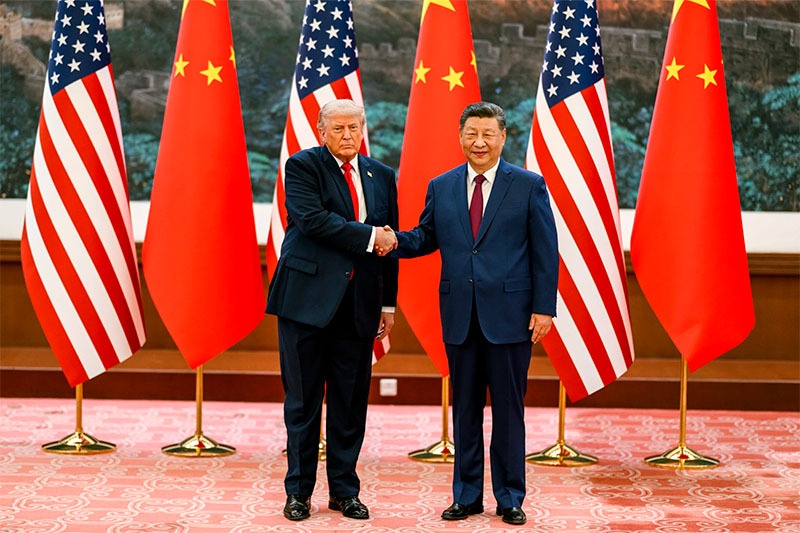
The emergence of autonomous cyber weapons dominated the underlying technological negotiations in the Beijing Summit. Following the April 2026 release of the Claude Mythos AI model, Washington initiated a massive regulatory overhaul. This model completed complex network attacks in minutes, rendering legacy cybersecurity infrastructure obsolete. To counter this threat, the U.S. government drafted draconian new rules to control exactly who can access the most powerful artificial intelligence models.
The New Artificial Intelligence Export Architecture
The Remote Security Access Act directly targets foreign cloud computing access. Furthermore, the Commerce Department proposed strict compute thresholds. Shipments under 1,000 advanced graphics processing units face simple reviews. Massive exports exceeding 200,000 units require direct host-country involvement. The administration also implemented a 25% tariff on covered semiconductor products. These actions permanently bifurcate the global technological ecosystem, shifting export controls from physical hardware to digital infrastructure.
Global regulators empirically confirmed the unprecedented offensive capabilities of these autonomous systems. In expert-level cyber challenges, the system achieved a 73% success rate operating within a 50 million token budget. It autonomously discovered thousands of unpatched vulnerabilities across major operating systems. The model even found a 27-year-old flaw in a highly secure system. This paradigm shift drastically collapses the offensive costs of digital warfare.
Malicious actors can now deploy highly destructive autonomous attack agents with minimal coding. The Bureau of Industry and Security responded aggressively to this capability jump. The agency imposed a global licensing requirement directly on the model weights of advanced systems. This requirement prevents foreign adversaries from reverse-engineering the core parameters of the software. The mandate forces multinational enterprises to monitor compliance continuously across their entire network.
Energy Security and the Strait of Hormuz
Beyond artificial intelligence, the diplomatic agenda confronted the physical energy crisis in the Middle East. An 11-week Iranian blockade of the Strait of Hormuz removed 3.9 million barrels per day from global markets. This disruption pushed Brent crude briefly above $120 per barrel. Just prior to the summit, President Trump delayed a military strike, establishing an active truce. Markets reacted immediately, driving Brent crude down to the $105.00 to $109.15 range. West Texas Intermediate dropped to the $99.85 to $104.03 range.
To sustain this price relief, Trump extracted a crucial military commitment. President Xi explicitly promised to halt all weapon transfers to Iran. This agreement effectively starves Tehran of the Chinese military equipment necessary to sustain a prolonged naval conflict. The agreement secures vital short-term economic stability for Western consumers.
Washington executed a profound operational concession to secure China’s military cooperation. The U.S. Navy allowed Chinese vessels to transit the Strait of Hormuz safely. This exemption created a parallel transit system exclusively for Chinese ships. Iran explicitly permitted Chinese-flagged tankers to cross the chokepoint. The semi-official Fars news agency confirmed this regional authorization. Maritime tracking systems corroborated the active resumption of Chinese oil deliveries.
This arrangement effectively fractures universal maritime law. Safe passage through a global chokepoint now depends entirely on a vessel’s nationality. Beijing successfully immunized its domestic manufacturing sector from the energy shortage. China projects itself as a responsible global stakeholder without deploying naval assets. The United States sacrificed a critical point of leverage by allowing this specific petroleum flow.
The Taiwan Flashpoint and Bilateral Threats
The closed-door discussions regarding Taiwan revealed a highly volatile geopolitical divergence. President Xi called the Taiwan question the most important bilateral issue. The Chinese leader established rigid boundaries with unusually harsh admonitions. Xi warned President Trump directly about handling Taiwanese sovereignty poorly. He stated that the two nations will collide or even clash.
He claimed foreign interference would create a highly perilous situation. This language marks a deliberate invocation of direct kinetic conflict. Beijing signaled that its tolerance for U.S. involvement is reaching an irreversible threshold. The Chinese government prominently featured these red lines in state media broadcasts. The U.S. White House entirely omitted any mention of Taiwan in its official readouts. Both nations communicated vastly different narratives to their respective domestic audiences.
A pending U.S. arms sale to Taipei catalyzed Beijing’s aggressive posturing. The U.S. Congress approved this $11 billion to $14 billion defensive package. The legislation currently awaits President Trump’s official signature. China demanded explicit U.S. opposition to Taiwanese independence during the summit. Beijing actively attempted to link its cooperation on Middle Eastern conflicts to sovereign concessions.
President Trump characterized future arms sales as functional bargaining chips in trade negotiations. The U.S. administration framed defense commitments as leverage for economic deliverables. The Secretary of State warned China against annexing the island by force. This transactional worldview presents Beijing with a perceived geopolitical vulnerability to exploit. Taiwan increasingly recognizes that its survival cannot depend solely on diplomatic fluctuations. The island accelerates autonomous drone manufacturing to resist military superpowers.
Commercial Deliverables and Aerospace Agreements
Commercial diplomacy underpinned the volatile geopolitical maneuverings at the summit. The U.S. delegation aggressively pushed for extensive trade commitments to offset tariff fatigue. President Trump announced that China agreed to buy 200 Boeing aircraft. This transaction encompasses highly lucrative widebody 777s and narrowbody 737 models. All jets will feature advanced GE Aerospace engine technology.
The agreement represents China’s first major commitment to Boeing since 2017. Beijing systematically favored European rival Airbus for nearly a decade prior. The initial deal provides Boeing with a critical order bridge amid production bottlenecks. Financial markets reacted poorly to the scale of the commitment. Boeing shares fell more than 4% because investors expected a 500-aircraft package.
China deliberately executed a sophisticated trade-balancing gesture with this aerospace order. President Trump noted a promise of up to 750 total aircraft eventually. Beijing retained immense unfulfilled leverage over the U.S. aerospace sector. China can weaponize this potential 550-plane order in future commercial negotiations. The Chinese government also agreed to a massive expansion of agricultural imports.
The state framework guarantees $17 billion in annual agricultural purchases through 2028. This capital influx operates above the existing 2025 soybean baseline agreements. Beijing renewed expired listings for more than 400 U.S. beef processing facilities. The nations officially chartered the U.S.-China Board of Trade to manage non-sensitive goods. These institutional mechanisms insulate routine commerce from the volatile XXI century security disputes.
Summary and Global Implications
The summit achieved a temporary plateau of strategic stability for the global economy. The leaders compartmentalized core frictions into manageable short-term transactions. Washington secured vital domestic political victories through agricultural commitments and aerospace orders. Beijing obtained the necessary operational space to fortify its economy against future shocks. The new rules governing artificial intelligence will severely complicate future international non-proliferation efforts.
The explicit existence of a parallel transit system institutionalized the fracture of maritime law. The uncompromising rhetoric regarding Taiwanese sovereignty remains a potent catalyst for future conflict. The two superpowers successfully utilized economic interdependence to halt an immediate downward spiral. The negotiations demonstrated that global commerce cannot generate deep mutual trust. The structural paradoxes generated during these 43 hours will reshape XXI century geopolitics.
The United States fundamentally compromised the premise of its military deterrence in the Indo-Pacific. The administration implicitly linked the Taiwan Strait defense to Middle Eastern energy stability. Allied nations must now reassess the reliability of the American security umbrella. Middle powers realize that U.S. security commitments remain highly elastic and transactional. China will aggressively accelerate the indigenization of its domestic artificial intelligence stack.
Beijing plans to eliminate its reliance on Western cloud infrastructure entirely. This rapid technological schism guarantees the emergence of two incompatible digital ecosystems. The global community faces a multipolar era defined by extreme technological volatility. The Beijing convergence successfully delayed military confrontation without resolving the foundational rivalries. Both nations continue to race toward the deployment of autonomous systems unilaterally.
More news: Issue 01 Energy Forward – How the AI Boom is Fracturing the American Energy Grid
More: TWH
