


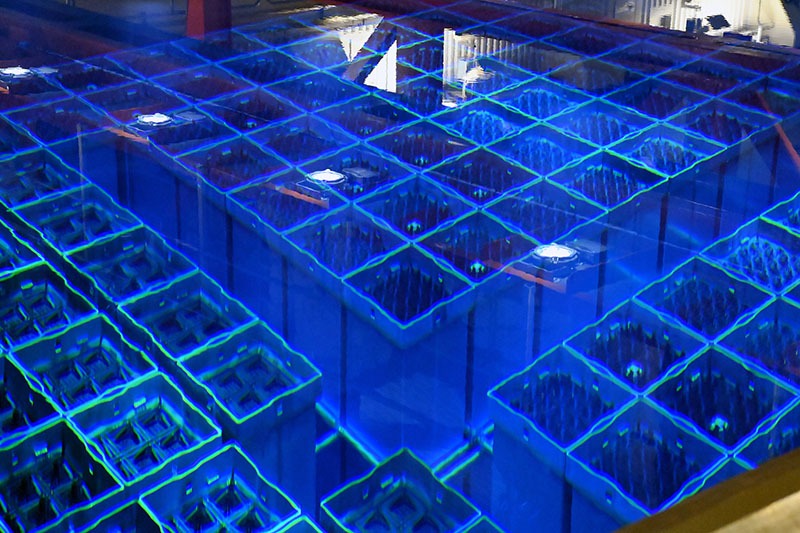
A distinct and captivating blue glow often emanates from the depths of nuclear reactor pools. This mysterious light represents a fascinating physical phenomenon known as Cherenkov radiation. Observers frequently notice this bright violet or blue hue when looking at the clear water surrounding nuclear fuel. The radiation provides a direct visual confirmation of intense subatomic activity happening beneath the surface. Scientists and nuclear inspectors rely on this visible energy to monitor radioactive materials globally.
The basic principles of physics dictate that nothing can exceed the speed of light in a perfect vacuum. However, the rules change significantly when light enters a different medium, such as water or glass. In these denser environments, light immediately slows down. This deceleration creates a unique opportunity for other subatomic particles to surpass the speed of light within that specific medium. This precise interaction generates the famous blue glow that captivates scientists and laypeople alike.
The phenomenon owes its name to the physicist Pavel Cherenkov, who made groundbreaking observations during the XX century. Cherenkov shared the 1958 Nobel Prize in Physics with his colleagues Ilya Frank and Igor Tamm. These scientists successfully demonstrated and explained the mechanics driving this brilliant blue luminescence. Their pioneering work transformed human understanding of particle physics and provided essential tools for modern nuclear energy management.
Breaking the Speed of Light
Physics establishes a universal speed limit. Nothing travels faster than light inside a complete vacuum. However, different mediums alter this fundamental rule. Water acts as a dense medium. When light enters water, it immediately decelerates. Light drops to 75% of its standard velocity. Meanwhile, charged particles like electrons and protons maintain their extreme speeds. These particles shoot through the water without slowing down significantly. Consequently, the particles travel faster than the light moves within that same water.
This specific condition triggers Cherenkov radiation. The charged particles exceed the local speed of light. This action forces a dramatic release of energy. The human eye perceives this energy as a brilliant blue flash. Scientists compare this event to a familiar acoustic phenomenon. The visual effect mimics the physical mechanics of a sonic boom. Aircraft create sonic booms when they exceed the speed of sound. Charged particles create an optical boom when they outpace light.
The Shockwave of Photons
Particles carrying an electric charge disrupt the environment. They aggressively disturb the atoms located along their path. The fast-moving particles break the energy equilibrium of these atoms. The affected atoms immediately attempt to regain stability. They release tiny packets of light to shed excess energy. Physicists call these light packets photons. The rapid emission of countless photons generates a powerful shockwave.
This shockwave manifests as the visible Cherenkov glow. The intense energies involved produce very specific types of waves. The photons travel in waves featuring high frequencies. These waves also possess very short lengths. High frequencies and short wavelengths correspond to specific colors. They align with the blue and violet sections of the color spectrum. Therefore, observers see a striking blue color in the reactor pools. The intensity of the blue color depends directly on the frequency. Higher frequencies produce a much brighter and deeper blue light.
Understanding the Color Spectrum
The visible spectrum contains various colors. Each color represents a different wavelength of light. The human eye detects only a narrow band of these waves. Cherenkov radiation covers a broad, continuous spectrum. Most of the emitted light actually falls outside human vision. The radiation produces massive amounts of ultraviolet light. Humans cannot see ultraviolet light without assistance. However, specialized scientific instruments detect these ultraviolet emissions easily.
The visible portion strongly peaks in the violet and blue regions. The water inside the reactor acts as a filter. The fluid absorbs some of the colors and transmits others. This filtering effect enhances the deep blue appearance. Nuclear facilities often feature large pools of pure water. The pure water allows the blue light to travel great distances. The visual result creates a beautiful but dangerous environment. The blue light signals the presence of extreme radiation. Personnel must always maintain strict safety protocols around these areas.
Historical Context and the Nobel Prize
The scientific community recognized this phenomenon early in the XX century. Pavel Cherenkov conducted meticulous experiments with radioactive materials. He observed the mysterious blue light emanating from liquids. Cherenkov proved that the light did not result from fluorescence. He established that the radiation had a completely different origin. His colleagues Ilya Frank and Igor Tamm provided the mathematical framework. They developed a comprehensive theory explaining the shockwave effect. The Royal Swedish Academy of Sciences recognized their monumental contribution.
The academy awarded the three scientists the 1958 Nobel Prize in Physics. Their discovery opened new pathways in nuclear physics. Researchers began using the Cherenkov effect to detect elusive particles. Scientists built massive underground observatories to capture these faint blue flashes. The discovery proved fundamental for the advancement of modern physics. It allowed physicists to study neutrinos and cosmic rays. The legacy of these three scientists continues to shape modern science.
Real World Observations in Chile
Nuclear research reactors provide excellent environments to observe this radiation. The RECH-1 reactor in Chile serves as a perfect example. The Chilean Nuclear Energy Commission operates this advanced facility. Photographs of the reactor core clearly show the characteristic blue glow. Thick layers of water surround the nuclear fuel inside the core. The nuclear reactions release billions of charged particles every second. These particles tear through the surrounding water at extreme velocities.
The water shields the environment from harmful radiation. It also creates the perfect medium for the Cherenkov effect. Observers looking down into the pool see a continuous blue halo. The halo outlines the exact shape of the active fuel elements. The brightness of the blue light indicates the reactor power level. Higher power levels generate more charged particles. More particles produce a much more intense blue luminescence. Engineers use this visual cue as a quick diagnostic tool.
The Role of Global Safeguards
Cherenkov radiation offers much more than a visual spectacle. It serves a critical function in global nuclear security. The International Atomic Energy Agency relies heavily on this phenomenon. The agency enforces international safeguards to prevent nuclear weapons proliferation. Sovereign states must declare their nuclear materials and facilities. They report the exact location, quantity, and composition of these materials. The agency dispatches highly trained inspectors to verify these declarations.
Inspectors use the Cherenkov glow to examine spent nuclear fuel. Nuclear power plants store spent fuel in massive cooling pools. The radioactive decay inside the spent fuel generates Cherenkov radiation. Inspectors measure this light without physically touching the dangerous fuel. This non-destructive testing method protects the inspectors. It also provides highly accurate data regarding the nuclear material. The glow confirms that the fuel assemblies remain intact. The absence of the blue light indicates a potential problem.
Advanced Detection Technologies
Technology improves the inspection process significantly. The agency utilizes sophisticated equipment to measure the emitted light. Inspectors carry the Next Generation Cherenkov Viewing Device during their missions. They also use the Digital Cherenkov Viewing Device for precise measurements. These advanced cameras detect the faint ultraviolet portion of the spectrum. The devices amplify the light and provide clear digital images. Inspectors point the cameras directly at the underwater fuel assemblies. The software analyzes the intensity and pattern of the Cherenkov light.
The resulting data reveals the exact history of the nuclear fuel. Inspectors compare this real-time data against the official state records. This comparison quickly highlights any discrepancies or missing materials. The digital devices work effectively even in partially illuminated facilities. The technology prevents states from secretly diverting nuclear material. It ensures that nations use nuclear energy strictly for peaceful purposes. The cameras represent a vital tool in the non-proliferation arsenal.
Securing the Future of Nuclear Energy
The global demand for clean energy continues to rise rapidly. Many nations expand their existing nuclear power programs. Other countries are constructing their very first nuclear power plants. This expansion increases the total amount of nuclear material worldwide. Consequently, the agency faces a growing number of facilities to monitor. The independent verification process maintains international trust and security. The Treaty on the Non-Proliferation of Nuclear Weapons anchors this system.
Article III of the treaty mandates comprehensive safeguard agreements. Every non-nuclear-weapon state must accept these strict agency inspections. The Cherenkov effect remains at the forefront of this verification effort. The simple physics of a blue shockwave safeguards the modern world. The combination of physics and international law prevents global catastrophes. Nuclear science provides both the energy to power cities and the tools to monitor it. The brilliant blue glow ensures transparency and accountability across the globe.
More news: The Dawn of a New Era in United States Energy Production
More: IAEA
Image source: IAEA
