


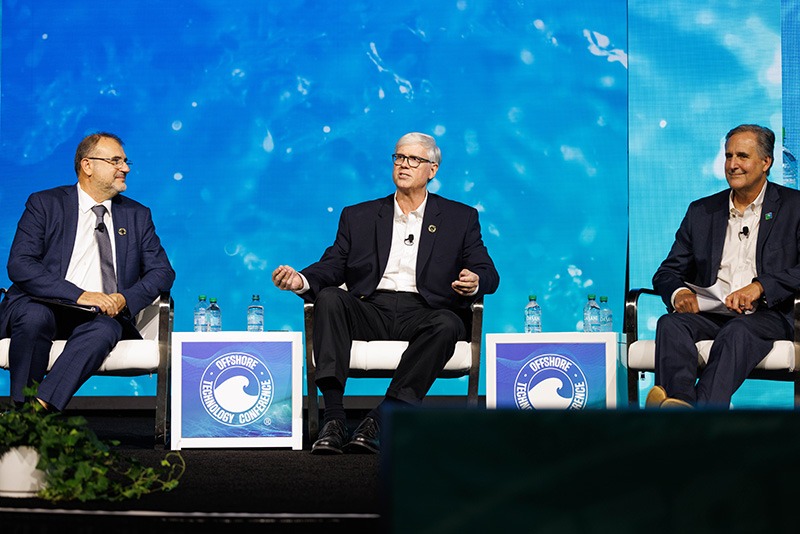
The 2026 Offshore Technology Conference (OTC) at NRG Park served as the definitive barometer for an industry caught in the crosshairs of global volatility. Gathering an estimated 30,000 visitors, 1,200 delegates, and over 1,000 exhibiting companies across 258,000 square feet of exhibition space, the event unfolded as a masterclass in crisis management and technological pivot.
For the energy experts navigating the halls, the immediate reality was dictated not by the exhibition floor, but by the maritime chokepoints of the Middle East. As the doors opened on May 4, 2026, a sudden blockade in the Strait of Hormuz halted the transit of roughly 20 million barrels per day. The immediate fallout sent U.S. West Texas Intermediate (WTI) futures surging over 3% to $105.46 per barrel. This macro-environmental shock framed the entire conference, accelerating the urgent need for secure, localized supply chains and advanced extraction methods in geopolitically stable basins.
The Demographic Shift and Resource Nationalism
A profound geopolitical realignment is reshaping the petroleum industry, and the demographics of OTC 2026 reflected this new reality. While 71% of attendees were domestic to the United States, a robust 29% represented international delegations. The audience was highly strategic, with executives comprising 24% of the crowd, cementing the conference as a hub for capital allocation rather than mere operational training.
The Global South utilized this executive concentration to broadcast a new set of rules. During the opening sessions, President Dr. Mohamed Irfaan Ali of Guyana introduced the “Guyana Doctrine.” Referencing the Yellowtail project (online in 2025) and the Uaru development (launching in 2026), he argued that emerging economies will not strand their hydrocarbons to satisfy the climate mandates of the Global North. While global energy investments hit $3.3 trillion in 2025, President Ali noted that achieving climate targets requires the U.S., Europe, and China to boost annual investments by 76%, 36%, and 30%, respectively.
Similarly, the Nigerian delegation established a rigid industrial mandate. Targeting zero gas flaring by 2030 and nearing a domestic refining milestone of one million barrels per day, Nigeria signaled that future offshore concessions will strictly require local technology transfer and the utilization of domestic engineering firms.
The Digital and Electrification Revolution
To survive the complex demands, operators are turning to aggressive technological evolution. The Spotlight on New Technology Awards honored 17 breakthroughs that highlight a distinct shift toward automation, electrification, and artificial intelligence.
General-purpose AI is prone to hallucinations, but i2k Connect’s EnRG-LLM—a winner in the small business category—solves this. Trained exclusively on over 300,000 technical papers, this domain-specific AI reduces manual research time by up to 90%, allowing operators to drastically accelerate asset valuation. In the realm of offshore wind, the Fugro GeoAI Framework is utilizing machine learning to automate seabed characterization, rapidly decreasing the lead time required to route subsea pipelines.
In complex deepwater, advanced metrology and autonomous execution dominated the technical sessions. SLB’s Retina At-Bit Imaging System translates physical cutter force into high-resolution wellbore images entirely immune to opaque drilling mud. This real-time visibility prevents catastrophic fluid losses. Downhole efficiency was further advanced by SLB’s FIV-III dual-trigger valve, which utilizes mud-immune fluid systems to open up to 12 hours faster using remotely operated vehicles and 6 hours faster on rig time. When deepwater drillship rates exceed $400,000 to $500,000 per day, these hours translate to massive capital savings.
Furthermore, the industry is systematically eliminating vulnerable hydraulic systems. Bosch Rexroth’s eSEA Push electric actuator is replacing traditional hydraulics, allowing operators to vastly extend the operational radius of subsea connections while eliminating the environmental risk of hydraulic fluid leaks into the ocean.
The Alternative Energy Pivot
While crude oil remains the financial engine, OTC 2026 dedicated unprecedented focus to alternative systems and the decarbonized future. The offshore sector is heavily pivoting toward Carbon Capture, Utilization, and Storage (CCUS) and offshore geothermal energy.
Oil States secured a Spotlight award for its GeoLok high-temperature geothermal wellhead. Designed for supercritical environments, it facilitates the delivery of 5 to 10 times more energy per well, a critical step in repowering coastal infrastructure.
Simultaneously, the maritime shipping industry’s transition to zero-carbon fuels was addressed by TB Global Technologies. Their Harmless Emergency Release System and CHOKUSEN contactless automatic connection system eliminate the fatal human and environmental risks associated with the offshore transfer of toxic ammonia, ensuring safe bunkering in rough seas.
The Climate Paradox and Non-Technical Risks
The highly capitalized optimism inside the exhibition halls stood in stark contrast to the civil disobedience outside. OTC 2026 occurred just after Earth Day (April 22), which sparked 6,000 protests across 180 countries against the expansion of fossil fuels.
Activists established picket lines in Houston, citing localized pollution and global climate volatility. This friction highlights the ultimate paradox of the modern energy sector: activists demand absolute divestment from hydrocarbons, while executives argue that rapid divestment during crises like the Hormuz blockade triggers catastrophic inflation and energy insecurity.
As the offshore sector moves, these sociopolitical tensions—alongside complex non-technical risks and legal battles—will dictate project timelines just as heavily as reservoir pressure or rig availability.
More news: BP Reports Strong First Quarter 2026 Financial Results Amid Dynamic Markets
More: OTC
