


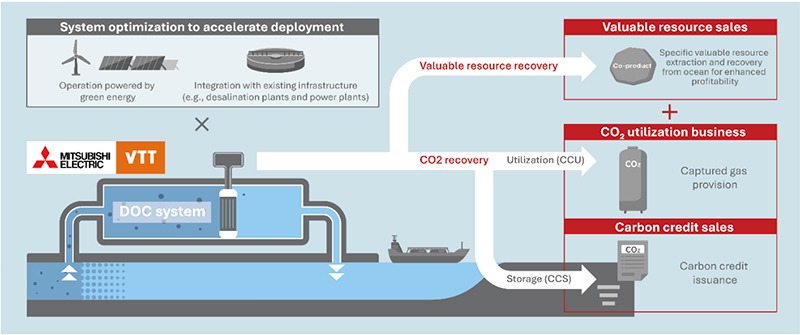
Global climate targets demand scalable solutions to remove residual carbon dioxide from the atmosphere. VTT Technical Research Centre of Finland and Mitsubishi Electric recently advanced a Direct Ocean Capture technology toward pilot-scale validation in early 2026. This electrochemical solution extracts dissolved inorganic carbon directly from seawater. The ocean represents the largest active carbon reservoir on the planet, holding approximately 38,000 gigatons of carbon.
Unlocking the Ocean Carbon Sink
This natural sink stores nearly 50 times more carbon than the Earth’s atmosphere. Every year, marine environments naturally absorb around 25% to 30% of human-made emissions. Direct Ocean Capture leverages this massive capacity by stripping carbon from the water, which allows the ocean to absorb more atmospheric gas. This method offers a promising negative emissions pathway to complement traditional reduction strategies.
The collaboration between VTT and Mitsubishi Electric launched in late 2024. The teams rapidly moved the concept from early-stage research into practical technology validation. Seawater contains roughly 125 times higher concentrations of carbon dioxide per unit volume compared to the air. This dense concentration makes marine extraction exceptionally efficient compared to Direct Air Capture systems. The new electrochemical approach temporarily acidifies seawater to release the dissolved gas.
Operators then capture this gaseous carbon for permanent geological storage or industrial utilization. The process handles large volumes of water continuously without requiring extensive heating or extreme pressure changes. Experts project the long-term removal potential of this marine approach could reach several gigatons per year. The successful validation phase now paves the way for commercial demonstration projects worldwide.
Electrochemical Technology Validation
Engineers designed the acidification-based process to avoid solid carbonate formation. The system selectively recovers carbon dioxide gas rather than storing it as a solid mineral. This flexibility allows industrial facilities to utilize the captured gas as a raw feedstock. Manufacturers can convert this recovered carbon into synthetic fuels, valuable chemicals, and other commercial products. The joint development effort validates the electrochemical mechanisms that drive this separation.
Researchers confirmed the system’s performance metrics through rigorous testing protocols over the past year. By proving the core technology works reliably, the developers significantly reduced the technical risks associated with scaling the equipment. The next phase involves deploying pilot plants to evaluate operational costs and energy efficiency metrics under real-world maritime conditions.
The project also establishes a strong foundation for secondary commercial benefits. The electrochemical process enables the selective recovery of valuable dissolved substances from seawater. Operators can extract useful marine minerals alongside the primary carbon removal operation. This side-stream utilization creates multiple revenue channels for the operating facilities. Facility managers can sell these recovered minerals to offset the energy expenses associated with the capture process.
Creating new value chains significantly strengthens the overall commercial viability of the technology. The developers aim to accelerate future demonstration initiatives by attracting new strategic partners. The consortium actively seeks investment to build commercial-scale units across various global markets. These economic incentives help drive sustainable business growth while addressing critical climate challenges directly.
Coastal Infrastructure Integration
Deployment strategies focus heavily on integrating the technology with existing coastal industrial sites. Desalination plants and large coastal power stations already process massive volumes of ocean water daily. Direct Ocean Capture systems can seamlessly tap into this pre-existing intake infrastructure. Utilizing current pre-treatment systems drastically reduces the initial capital investment required for new capture facilities. Plant operators avoid building expensive new pipelines and offshore pumping stations.
This synergetic approach maximizes land use efficiency in heavily developed coastal regions. Facilities that incorporate these systems essentially upgrade their operations to serve as carbon removal hubs. Engineering teams plan to retrofit several active industrial sites to demonstrate this seamless integration. The technology transforms conventional infrastructure into active climate mitigation tools without disrupting primary operations.
This modular approach ensures the technology can scale globally to match ambitious climate goals. Coastal regions worldwide possess the necessary industrial density to support widespread deployment networks. Combining low-carbon electricity with ocean capture creates a highly sustainable cycle of negative emissions. Governments increasingly recognize marine carbon removal as a crucial component of future environmental policy. Regulatory frameworks now encourage industrial sectors to adopt these advanced electrochemical solutions quickly.
Achieving carbon neutrality requires robust complementary methods alongside aggressive emission reduction mandates. Direct Ocean Capture presents a viable, high-impact mechanism to tackle hard-to-abate industrial emissions effectively. The collaboration between these international entities marks a defining step toward a cleaner atmosphere. The global community eagerly anticipates the results of the upcoming commercial pilot programs.
More news: BP Consolidates Operations Into Two Segments to Accelerate Growth
