


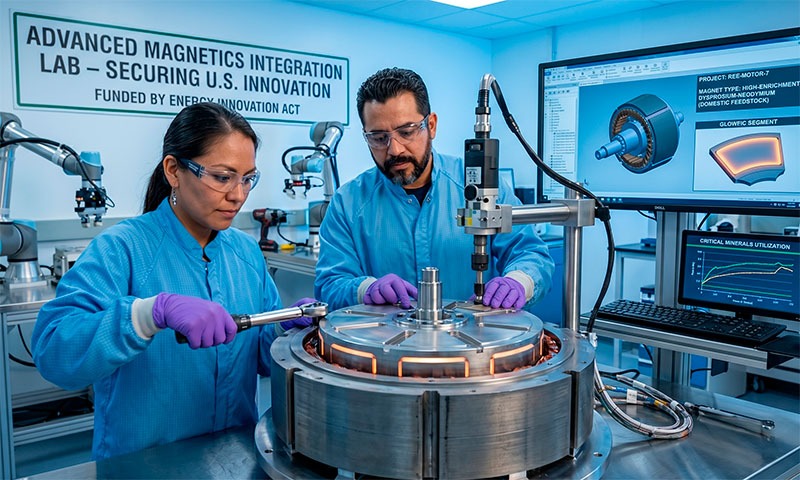
The United States Department of Energy announced a major financial commitment in June 2026 to strengthen domestic supply chains for critical materials. Officials dedicated $134 million to develop new commercial pathways for extracting and refining rare earth elements. The Office of Critical Minerals and Energy Innovation selected two specific demonstration projects to lead this initiative.
Securing Vital Resources
These carefully chosen projects aim to reduce American reliance on foreign sources for essential materials. By targeting unconventional feedstocks, the government plans to improve national energy security and build a more resilient industrial base. This funding specifically targets methods that recover valuable resources from discarded industrial waste. The initiative marks a significant step toward achieving domestic energy independence while simultaneously addressing environmental concerns related to existing waste sites.
Rare earth elements play a fundamental role in modern technological development and advanced manufacturing sectors. Industries desperately need elements like praseodymium, neodymium, terbium, and dysprosium to manufacture high-performance components. Manufacturers utilize these specific elements to build powerful magnets, electric motors, power generation systems, and advanced defense technologies. Historically, companies struggled to source these materials domestically, leaving the American supply chain vulnerable to international market disruptions.
The newly funded demonstration facilities will process overlooked resources such as electronic waste and mine tailings instead of relying on traditional mining operations. This innovative approach establishes a commercial process that extracts maximum value from previously discarded materials. Engineers will separate mixed rare earth oxides and refine them into pure metals for direct industrial application.
Processing Industrial Waste
The Colorado School of Mines leads the first major project funded by this federal initiative. Researchers will design and operate a new demonstration facility near the Gramercy alumina refinery in Louisiana. The plant will process “red mud,” which represents a highly abundant bauxite waste product rich in critical minerals. Through this facility, engineers plan to demonstrate the complete commercial feasibility of an integrated extraction and refining process.
The team will collaborate with Pacific Northwest National Laboratory, ElementUSA, Principal Mineral, and Rare Earth Technologies Inc. Together, these organizations will transform hazardous industrial byproducts into valuable rare earth metals. This collaboration directly supports the ultimate goal of establishing a functional, closed-loop domestic supply chain for high-demand technology manufacturing components.
Phoenix Tailings directs the second major project under this federal funding umbrella. The company will build a demonstration-scale facility to produce high-purity rare earth metals. Engineers will utilize domestic industrial waste to feed this new operation. This specific project establishes a brand new commercial pathway for heavy rare earth metals. The initiative heavily relies on strong institutional partnerships to ensure commercial success.
Phoenix Tailings will collaborate closely with the Massachusetts Institute of Technology. The University of Minnesota also serves as a primary academic partner for this endeavor. These teams will develop innovative techniques to refine complex industrial waste streams safely. The United States currently lacks the infrastructure to perform these specific separation processes domestically. This facility aims to close that crucial gap in the manufacturing sector.
Building a Resilient Supply Chain
The Rare Earth Elements Demonstration Facility Program strictly manages this lucrative funding opportunity. The Manufacturing Deployment Office oversees the entire administrative process for both selected projects. Federal guidelines require award recipients to provide a substantial financial commitment. Organizations must contribute a cost-share of at least 50% to receive the federal grants. This rule ensures private partners remain fully invested in the commercialization process.
Assistant Secretary of Energy Audrey Robertson emphasized the importance of overlooked resources. She stated that America needs to extract value from waste to achieve true energy independence. Expanding domestic recovery capabilities directly reduces vulnerability to foreign supply chain bottlenecks. The financial structure guarantees that taxpayer dollars support viable, long-term commercial operations. These investments ultimately protect the nation against sudden international trade restrictions.
Domestic energy security relies completely on continuous access to critical minerals. Foreign nations currently dominate the global market for rare earth element refinement. The 2026 funding initiative fundamentally shifts this unbalanced dynamic back toward American manufacturing. Turning toxic mine tailings into high-performance technology components offers incredible environmental benefits. It actively cleans up legacy industrial sites while producing vital manufacturing materials.
The successful operation of these two demonstration facilities will transform American industry. Engineers expect these pilot programs to scale up into massive commercial refineries eventually. The government plans to continue funding similar sustainable resource extraction technologies. American companies will soon manufacture advanced defense systems and electric motors using fully domestic materials. This bold strategy secures the technological future of the United States.
More news: Scaling Marine Technology for Global Climate Targets
More: DOE
