


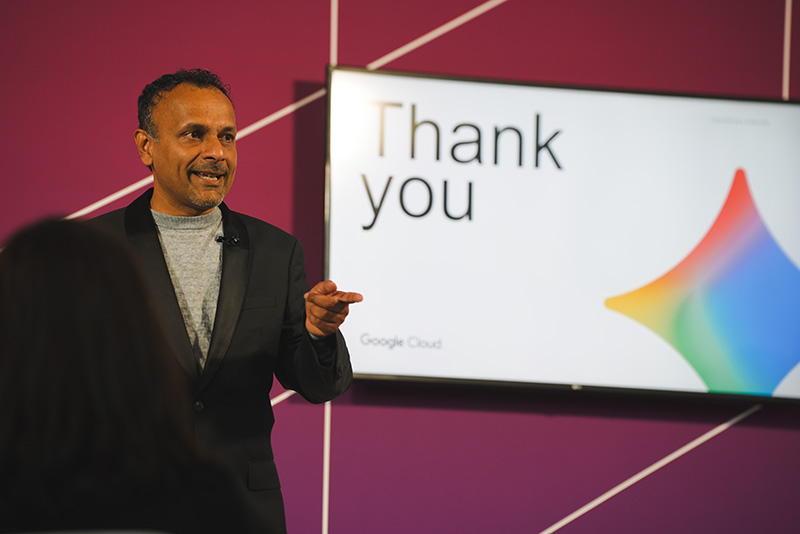
The era of experimental artificial intelligence ends today. Energy companies now face a massive operational shift. Vishal Agarwal addressed the crowd during the conference. Agarwal works as the Global AI Blackbelt for Google Cloud. He presented a new concept called the New Energy Stack.
Moving Beyond the Chat Interface
This framework deploys Gemini agents across the entire energy value chain. These agents operate as highly proactive digital teammates. They solve mission-critical energy challenges for large corporations. They move far beyond simple chat interfaces. The agents execute complex operational workflows automatically. They integrate directly with proprietary enterprise data. This deep integration drives enterprise-wide safety, performance, and efficiency.
People feel completely limitless with technology in their personal lives. A massive disconnect currently exists in the corporate workplace. This disconnect does not stem from a lack of technology. It stems entirely from a lack of trust. Companies must solve this fundamental trust issue immediately. The XXI century demands a shift toward breakthrough work.
Breaking Down Data Silos
The average enterprise operates 106 separate software applications in 2026. Some large corporations manage hundreds of distinct software systems. These complex systems rarely communicate with one another. Employees quickly stop trusting the data when systems fail to connect. Workers then transform into reluctant middle managers. They become full-time stewards of corporate data.
They spend endless hours moving information between isolated platforms. Studies show professionals spend 36% of their time on administrative tasks. This massive data sprawl causes severe industry inefficiency. Companies usually try to solve this as a systems problem. Agarwal suggests a completely different approach. He proposes focusing entirely on the human element.
“How do we free our people to transform from busy work to breakthrough work?,” Agarwal asked the audience. The ultimate goal involves unleashing team creativity. Technology exists to serve people efficiently. People should never have to adapt to technology. Workers no longer need to learn complex programming languages. They can simply converse with artificial intelligence systems naturally.
The Mechanics of Gemini Enterprise
Gemini Enterprise functions as a comprehensive digital platform. It does not act as just another isolated application. The platform contains several distinct and powerful components. The brain utilizes the highly sophisticated Gemini artificial intelligence model. The workbench allows anyone to create autonomous agents quickly.
The task force provides pre-built agents for immediate corporate leverage. The context connects the system directly to proprietary company data. The governance provides strict guardrails for responsible daily use. These tools empower everyday workers across the energy sector. They transform standard employees into active problem solvers. A safety manager with 20 years of experience can build an agent.
This manager requires absolutely zero coding experience. The manager creates an automated workflow for incident reports. The agent receives an email and looks up the asset ID. It checks the maintenance record and notifies the regional manager. The company unlocks institutional expertise instantly. Employees do not need to become software developers to succeed.
Empowering the Data Scientist
The energy sector requires heavy data analysis every single day. A data scientist might want to predict complex equipment failures. This professional can use Gemini Enterprise to write full code. The scientist combines real-time sensor data with external weather models. The artificial intelligence agent then deploys this predictive model autonomously.
The platform meets users exactly where they currently work. It adapts seamlessly to different technical skill levels. Analysts project the global artificial intelligence market in energy will reach $22.6 billion by 2033. This represents a massive compound annual growth rate. The industry demands measurable efficiency and strict risk mitigation.
Integrating artificial intelligence directly impacts the corporate balance sheet. Pre-built agents offer immediate leverage on day one of implementation. Third-party providers constantly add new agents to the growing ecosystem. Context remains the most crucial element for building user trust. Companies connect emails, chats, and hundreds of internal applications. The artificial intelligence agents keep this institutional knowledge at their fingertips.
The Co-Scientist Breakthrough
The shift from prediction to action marks a massive technological leap. Google Cloud currently demonstrates an early autonomous agent called Co-Scientist. This tool acts as a dedicated digital assistant for researchers. Traditional research processes require extensive manual labor. Researchers must read and analyze copious amounts of complex material. The co-scientist agent changes this dynamic entirely.
The agent can run autonomously for 24 uninterrupted hours. A researcher simply asks the agent to solve a specific problem. The agent generates scientifically grounded hypotheses rapidly. It reviews the data and challenges its own conclusions. Agarwal explained this process in detail during the event. “Co-scientists, which is our autonomous agent, can actually run for hours,” Agarwal noted.
He added that the agent provides “scientifically grounded hypotheses for what those ideas could be that I can then go test.” The agent does not make final corporate decisions. It provides a sandboxed environment for autonomous exploration. This represents a low-risk entry point for major energy firms.
Responsible Artificial Intelligence
Governance provides the necessary framework for widespread enterprise adoption. Leaders need strict guardrails before deploying artificial intelligence across networks. Many view rapid innovation and responsible governance as opposing forces. Google Cloud views them as highly complementary elements. Agarwal compared this dynamic to driving a fast vehicle.
“It’s like driving a fast car without brakes,” Agarwal stated. “The only reason you would drive a fast car really fast is when you rely on the brakes, so you know that it’ll stop.” This governance platform allows companies to build secure operational parameters. Generating a monthly safety report used to take several days. It required endless searching through highly fragmented information.
Now, workers simply give a clear mission to an autonomous agent. The output is not just a standard generated report. The output is operational speed and worker confidence. Engineers go home feeling accomplished rather than entirely drained. They avoid clicking through endless digital compliance forms.
Connective Tissue Over Replacement
Many industry professionals question the future of existing enterprise systems. Some wonder if artificial intelligence will replace enterprise resource planning networks. Google Cloud does not view the technology in this destructive manner. Existing enterprise systems were purpose-built for very specific reasons. Gemini Enterprise acts as a connective tissue instead.
It functions as a digital glue sitting on top of current software. This layer helps automate complex tasks across various corporate departments. It takes a business-centric and people-centric approach to automation. Developers actively build both first-party and third-party software connectors. These connectors link the artificial intelligence to the broader ecosystem.
This solves major interoperability issues at the physical hardware layer. The energy sector utilizes countless distinct sensors and hardware systems. Cloud platforms allow companies to bring this diverse data together. The integrated stack processes the relevant information seamlessly. The agents then execute actions based on this unified data.
Processing Multimodal Information
The energy industry generates vast amounts of unstructured operational data. Critical information often stays locked in videos, photos, and complex diagrams. Legacy software struggles to process these visual formats effectively. Gemini models process multimodal data natively and efficiently. This unique capability unlocks entirely new operational workflows for companies.
Autonomous agents can directly see and understand technical engineering schematics. They can analyze drone footage of remote pipeline infrastructure. This minimizes the grueling manual work required from human teams. The platform also offers a highly specialized deep research agent. This tool cuts research time from days down to mere minutes.
It frees developers from managing crippling technical debt. Developers can then focus on the most pressing energy challenges. The core objective remains consistent throughout the entire integration process. Companies must transform basic grunt work into highly valuable strategic work. The flywheel effect begins after a company deploys its first successful agent.
Continuous Hardware Innovation
Software innovation requires equal advancements in physical hardware infrastructure. Google developed its own custom chips to support these models. The company recently released several new protocols to improve agent communication. These include the Model Context Protocol and specific Agent-to-Agent protocols.
This hardware and software combination creates a unique corporate mindset. It focuses entirely on continuous technological breakthroughs. Alphabet reported improving its custom chip power efficiency significantly since 2018. This hardware efficiency directly benefits energy clients running complex AI models. These clients align with a very specific technological belief. They believe technology must actively serve the human workforce.
Solving human problems automatically solves major business problems. This philosophy drives the development of new energy technology stacks. Artificial intelligence agents will continue to handle repetitive administrative duties. Human workers will reclaim their valuable time for critical thinking tasks.
The Future of Energy Leadership
Human beings possess highly unique critical thinking abilities. They excel at making complex, nuanced, and strategic decisions. Artificial intelligence models continue to improve their foundational capabilities rapidly. They score higher on benchmark evaluations every single year.
However, their true value lies in iterative problem-solving processes. Agents can ask the same exact question from multiple different angles. They climb a digital hill to find the optimal scientific answer. The ultimate success in the energy sector will not come from technology alone. The future belongs to progressive companies that actively liberate their workforce.
“We believe that the future of energy is not going to be changed by companies that have the best technology, but by companies that really enable their people to be free so that they can actually do breakthrough work,” Agarwal concluded. Creating an environment that unleashes human creativity remains the ultimate challenge. The tools now exist to make this bold vision a reality.
More news: TotalEnergies’ Funds to Natural Gas Projects
More: CERAWeek
