


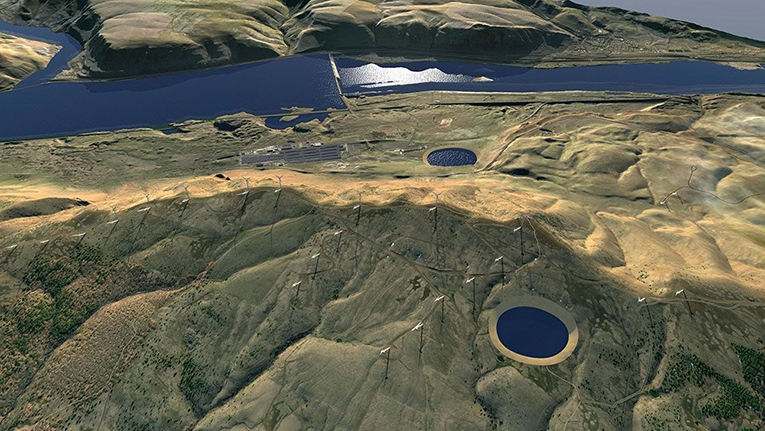
Rye Development, a leading U.S. hydropower developer with a current pipeline of over 25 projects in 10 states, has started the development of the Lewis Ridge Closed-Loop Pumped Hydropower Storage project in Bell County, Kentucky.
Firstly, the announcement remarks that Rye Development has already filed for a Federal Energy Regulatory Commission (FERC) permit for the project. The Leis Ridge project will be located adjacent to the Cumberland River near the communities of Blackmont, Tejay, Balkan, and Callaway.
Moreover, the project will sit on a former coal strip mine and will be surrounded by an active coal mining area. However, as coal is phasing out from the nation’s energy mix, coal communities face uncertain employment and economic futures. Consequently, the Leis Ridge project will have a solid economic impact on the region.
Notably, the project will invest nearly $1 billion dollars into the county; bring close to 2,000 family-wage construction jobs over a 3 to 5-year period; and will also create several dozen direct and indirect family-wage jobs during project operations.
Also recommended for you: NovaSource acquires Heliolytics to expand lifecycle services. Click here to read.
Rye Development to bring numerous benefits for the surrounding coal communities
Furthermore, when fully permitted, the project would receive a 50-year license to operate. Paul Jacob, CEO of Rye, said about the matter. “Rye is proud to bring these types of developments to coal communities in the US; delivering on the promise of jobs in the energy transition. The Lewis Ridge project marks a significant step forward in the push toward a more renewable energy grid.”
On the other hand, the project is relevant as long-duration electricity storage; particularly pumped storage hydro, will help solve the renewable’s intermittency. In addition, closed-loop pumped-storage facilities are systems that move water between a man-made lower reservoir and a man-made upper reservoir.
Then, hydroelectric turbines generate electricity from the water going on in that process thousands of times, without any water waste. Consequently, pumped storage offers a flexible solution to the changing grid; including the ability to store intermittent solar and wind resources moving forward.
Finally, when fully operational the Lewis Ridge project will have a 200MW capacity, for 8 hours. Pumped storage facilities are the most common form of energy storage in the U.S., representing 95% of all utility-scale storage, according to the U.S. Dept. of Energy.
