


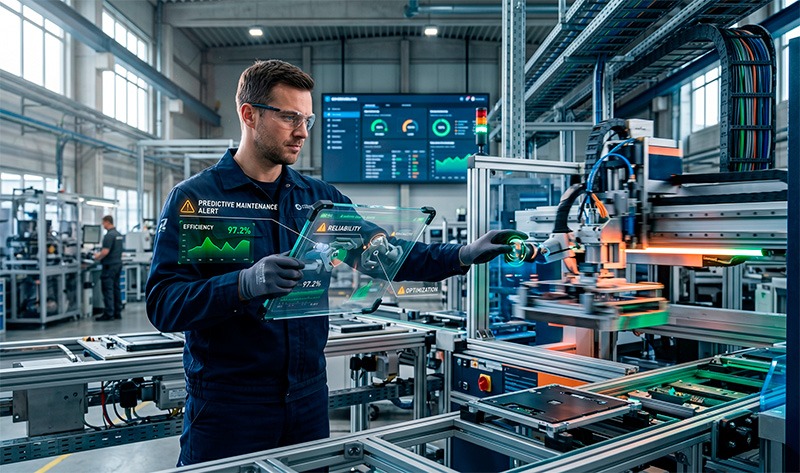
Industrial companies face unprecedented complexities across the global market. Manufacturers navigate severe supply chain disruptions, skilled labor shortages, and geopolitical tensions. However, industry leaders no longer treat digital transformation as a simple initiative. Here comes Smart Manufacturing.
These companies now deploy advanced technology as the core operating system of the modern industrial enterprise. The eleventh annual State of Smart Manufacturing Report by Rockwell Automation highlights a massive shift in corporate strategy. Operations now move rapidly from early adoption to full-scale execution.
A staggering 90% of manufacturers state they need digital transformation to remain competitive in today’s environment. Executives focus heavily on creating resilient operations that anticipate conditions and automate critical decisions. Intelligent autonomous systems fuel the future of industrial production.
This modernization drives operational improvements and creates greater agility. Companies invest heavily in artificial intelligence and interoperable environments that make data actionable.
Manufacturers dedicate 28% of their operating budgets to industrial technology. This financial commitment proves that organizations no longer just explore digital tools; they implement them across the board. Currently, only 18% of respondents remain in the pilot phase for smart manufacturing technologies. Meanwhile, 59% actively use these advanced tools to support daily operations. The industrial sector demands total alignment among systems, teams, and data.
Artificial Intelligence Drives Results
Artificial intelligence rapidly advances operational intelligence across global manufacturing environments. Organizations transition from fixed automation to adaptive systems that optimize themselves continuously. Current data shows that AI augments 48% of active operations today. Analysts project this figure will reach 54% by the year 2030. Companies utilize machine learning to support fundamental functions like quality control and process optimization.
An overwhelming 83% of manufacturers consider artificial intelligence the primary driver of successful business outcomes. Leaders prioritize investments that increase flexibility and resilience throughout the production lifecycle. They deploy robotics and digital twins to execute tasks efficiently. The industry expects autonomous agents to handle half of all business decisions by 2027. This technological shift enables systems to manage variability and reduce operational risks effectively.
Manufacturers seek measurable results from their digital transformation efforts. They focus primarily on improving product quality, reducing overall costs, and minimizing operational risks. Quality improvement stands out as the main goal for 46% of industrial companies. Cost reduction drives strategy for 40% of the surveyed organizations. Meanwhile, 36% of leaders implement digital tools specifically to mitigate risk.
Businesses successfully achieve these results by expanding automated material movement and simulation capabilities. They abandon isolated use cases in favor of comprehensive end-to-end execution. Advanced algorithms process complex variables to adjust machinery settings instantly. This proactive approach prevents defects before they occur on the assembly line. Facilities achieve unprecedented efficiency levels through interconnected smart platforms. The integration of machine learning transforms raw production data into immediate competitive advantages.
Data Bottlenecks and Cybersecurity Threats
Organizations gather more operational data today than at any point in history. However, most facilities struggle to utilize this vast information effectively. Companies successfully leverage only 43% of the data they collect. The true competitive gap lies in the ability to contextualize and act upon this information. Operational intelligence serves as the foundation for artificial intelligence and autonomous systems.
Systems fail to reach their full potential without reliable data flowing seamlessly across all platforms. Unreliable data creates significant bottlenecks that slow down critical business decisions. Information must trigger coordinated actions to generate real value on the factory floor. Manufacturers require robust architectures that transform disjointed metrics into actionable intelligence. This capability directly accelerates performance and strengthens market positioning against industry rivals.
Increased digital connectivity directly amplifies severe cybersecurity risks across manufacturing operations. About 46% of respondents experienced a cyber incident during the past year. Cybersecurity now represents a constant operational requirement rather than an episodic concern. Malicious attacks target IT systems, enterprise networks, and critical integration points. These vulnerabilities threaten the foundation of highly automated and intelligent production facilities. Companies must design resilience for scale and rapid recovery.
Autonomous systems simply cannot function securely without integrated protection protocols. Exactly 34% of industry leaders cite cybersecurity alongside energy costs as their primary external challenge. Safety forms the absolute prerequisite for factory autonomy. Organizations deploy advanced security controls to protect their intellectual property and maintain continuous operations. Robust defense mechanisms ensure uninterrupted production cycles despite global digital threats.
Workforce Redefinition Strategies
Smart manufacturing fundamentally rewrites roles, skill sets, and operational expectations. Companies actively use artificial intelligence to augment their personnel rather than replace them. Exactly 93% of surveyed manufacturers expect to redefine their workforce moving forward. This transition represents a structural shift toward dynamic and adaptable daily operations. Organizations consider reskilling an essential business capability rather than an ambitious initiative.
Last year, 40% of manufacturers actively retrained their staff to handle new technologies. Employees shift their focus from manual labor to critical communication and collaboration. Technology clearly drives efficiency, but human workers ultimately secure long-term business results. Successful enterprises invest equally in human capital and digital automation tools. Factories require skilled technicians to manage sophisticated control systems and interpret complex analytics.
Management teams explore various strategies to build a highly adaptable workforce. Approximately 50% of companies plan to reassign new roles to their existing workers. Another 42% intend to hire new talent for entirely different operational positions. Around 35% of manufacturers recruit individuals to fill established technical roles. Meanwhile, 31% rely on external outsourcing to meet their immediate labor demands.
Companies recognize that skilled talent ranks among the highest requirements for beating the competition. A severe shortage of qualified workers consistently threatens overall business growth. Leaders partner with educational institutions to develop specialized training programs. They create detailed blueprints to turn strategic visions into sustained operational performance. Modern facilities empower their employees with intelligent tools that accelerate learning and amplify human judgment.
More news: How Downstream Operations Power Daily Life
