


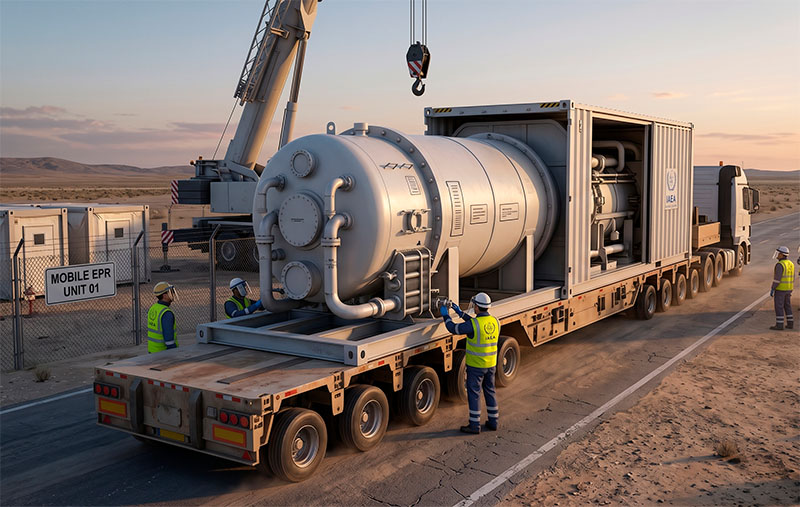
Current emergency frameworks focus on several hundred large, stationary nuclear power plants. However, future energy demands require a completely different approach, like the Mobile Nuclear Reactors. The world will soon manage thousands of smaller reactors distributed across remote areas and industrial sites. Operators will even transport mobile reactors by ship or truck to meet fluctuating power needs.
A Shifting Global Energy Landscape
This dramatic shift requires modern emergency preparedness and response strategies. Small modular reactors and floating plants present unique operational characteristics. Analysts project that these new systems could comprise up to 40% of new energy deployments by 2050. The International Atomic Energy Agency works diligently to align safety measures with this rapid technological innovation.
Developing traditional emergency scenarios takes months of complex coordination. Authorities now look toward artificial intelligence to revolutionize this outdated process. Machine learning programs already gather extensive maintenance data from existing facilities. Future operators will utilize advanced language models, aerial drones, and ground robots to monitor nuclear plants in real time. These automated systems will feed data directly into sophisticated algorithms.
The technology will create digital twins, which serve as highly detailed simulations of actual power plants. Planners will use these virtual models to run emergency scenarios, calculate risks, and update response protocols instantly. Experts estimate that this technological leap will improve response efficiency by nearly 100%. Artificial intelligence guarantees faster adaptation to emerging threats.
Tailoring Strategies for Small Modular Reactors
Small advanced reactors introduce unique emergency planning considerations. Their compact dimensions and enhanced safety features significantly reduce the likelihood of severe accidents. Consequently, some industry experts argue for smaller emergency planning zones around these new facilities. Yet, the actual situation presents far more complexity. Monica Dobbertin, an emergency preparedness coordinator, notes that standardized designs do not justify a universal planning approach.
A specific site might host a single isolated reactor. Conversely, another location could operate multiple interconnected reactors that match the scale of traditional large plants. Therefore, emergency managers must customize response plans to the exact layout, location, and operational context of each site.
Mobile reactors add another significant layer of complexity. Ships and trucks transport these units across various national borders. This constant movement demands flawless international communication. Authorities in all affected regions must coordinate their safety protocols. This coordination ensures safe and secure transit for every reactor. Wolfgang Picot emphasizes this critical need in his original report.
Planners must establish clear guidelines for these mobile energy sources. The International Atomic Energy Agency currently updates its safety standards. These updates address the unique challenges of mobile and small reactors. The agency continuously guides countries through this transition. Global cooperation prevents potential jurisdictional conflicts during a crisis. Every nation must share information openly.
Integrating Innovation with Permanent Safety Standards
The rapid evolution of nuclear technology requires immediate action. Regulators fully recognize the need for updated emergency frameworks. The International Atomic Energy Agency actively integrates new technologies into its guidelines. The agency recently revised the core preparedness and response safety standards. Officials strongly recommend an all-hazards approach for every facility.
This approach forces operators to consider absolutely all possible threats. Emergency plans must cover large stationary reactors and tiny microreactors alike. Advanced technology will undoubtedly change how teams execute emergency responses. However, regulators maintain the fundamental safety requirements permanently. Monica Dobbertin confirms this steadfast commitment to baseline security. Institutions must adopt innovation without compromising public safety. New guidelines protect communities from unexpected variables.
Nuclear Power Incredibly Safe
The nuclear sector faces its most significant transformation in decades. Artificial intelligence and advanced reactor designs provide incredible opportunities. These combined innovations will make nuclear power incredibly safe. Energy companies will deploy new facilities globally at an unprecedented rate. Authorities face the major challenge of managing this rapid technological change.
Emergency preparedness strategies must evolve alongside these brilliant engineering achievements. International cooperation definitely guarantees the industry’s future success. Nations must immediately align their internal policies with established global guidance. Wolfgang Picot highlights that modern preparation actively prevents future disasters. Operators will test complex scenarios efficiently through advanced digital simulation. This proactive strategy perfectly protects the environment and local populations. The future of clean energy depends heavily on flawless emergency execution.
More news: TotalEnergies Balances Record Shareholder Returns
More: IAEA
