


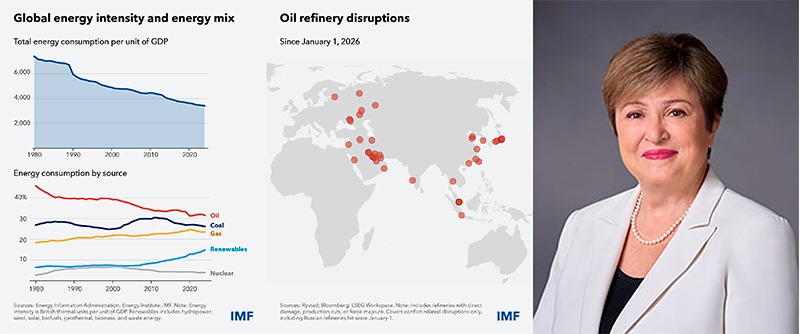
The International Monetary Fund evaluates the massive economic fallout from the recent Middle East conflict. The organization prepares for the 2026 Spring Meetings with a sharp focus on global resilience. A massive supply shock disrupts international markets and triggers widespread economic suffering. The conflict creates a huge challenge for central banks and financial ministries worldwide. Policymakers must formulate effective strategies to mitigate the ongoing financial distress.
The crisis manifests as a severe and asymmetrical global supply shock. Daily global oil flows plummet by 13% while liquid natural gas supplies drop by 20%. The sudden scarcity drives energy costs upward across all continents. Brent crude oil prices surge from $72 per barrel to a staggering peak of $120. While prices have shown slight moderation recently, nations continue paying extreme premiums for essential energy supplies.
Small island nations suffer immensely due to their position at the end of long supply chains. The conflict forces these vulnerable states to question their basic fuel security. Interrupted supply lines generate cascading failures across multiple industries. Analysts warn that the XXI century economy remains highly susceptible to regional geopolitical disruptions. The situation demands immediate and coordinated international action.
Cascading Effects Across Supply Chains
The energy crisis triggers immediate domino effects globally. Refineries shut down operations due to erratic supply flows. These facilities require a steady volume to maintain production. The disruptions cause severe shortages of refined petroleum products. Diesel fuel and aviation gas are becoming increasingly difficult to procure. Transportation networks struggle to maintain regular schedules. The shortage cripples global trade mechanisms and halts international tourism. Modern economies rely heavily on these interconnected logistics networks. The conflict exposes the deep vulnerabilities of globalized commerce.
Food insecurity accelerates rapidly as transportation costs explode. The logistical nightmare pushes 45 million additional people into hunger. The total number of starving individuals now exceeds 360 million globally. Surging fertilizer prices threaten to worsen the agricultural crisis soon. Farmers cannot afford the essential nutrients for their crops. Future harvests look exceptionally bleak. A prolonged disruption guarantees higher food prices for consumers everywhere. Governments scramble to secure basic grain supplies for their populations. The agricultural sector demands immediate stabilization measures.
Industrial Bottlenecks and Material Shortages
Industrial manufacturing faces crippling raw material shortages. Factories exhaust their reserves of critical chemical inputs rapidly. Silicon chip manufacturers cannot source enough helium for production lines. Medical facilities face similar helium shortages for magnetic resonance imaging machines. Plastic manufacturers struggle to locate adequate supplies of naphtha. The modern technology sector depends entirely on these specific materials. Without them, consumer electronics production grinds to a halt. Supply chain managers report unprecedented delays in component deliveries. The manufacturing sector anticipates significant quarterly losses.
Companies attempt to find alternative suppliers without much success. The global market simply lacks the required excess capacity. Competitors bid aggressively against each other for the remaining stockpiles. This bidding war drives raw material prices even higher. Small businesses suffer the most under these extreme market conditions. Large corporations utilize their massive cash reserves to secure limited resources. The imbalance threatens to bankrupt thousands of smaller manufacturing enterprises. Regulators monitor the situation closely.
The Qatar Facility Disruption
The Ras Laffan complex in Qatar exemplifies the profound infrastructure damage. This massive facility historically produces 93% of the Gulf’s liquid natural gas. Asian markets consume 80% of this specific output. The region now faces a catastrophic fuel deficit. Operations at the complex halted completely on March 2. A direct military attack struck the critical infrastructure on March 19. The damage assessment paints a very grim picture for future production. Engineers evaluate the massive destruction across the production lines.
Rebuilding the facility requires extraordinary engineering efforts and massive capital. Experts estimate the recovery timeline at 3 to 5 years. A quick return to normal operations remains completely impossible. Regional energy grids must rely on heavily polluting alternatives in the meantime. Coal power plants resume operations to cover the massive energy shortfall. Environmental targets suffer a massive setback due to this conflict. The energy transition stalls as immediate survival takes priority. Planners struggle to redesign the damaged infrastructure.
Shipping Routes and Global Trade
Maritime trade routes experience unprecedented congestion and danger. Commercial vessels actively avoid the Bab el-Mandeb Strait entirely. Cargo companies redirect their massive fleets around the African continent. This detour adds weeks to standard shipping schedules. Traffic through the Red Sea languishes at exactly half of the 2023 volume. Insurance companies charge astronomical premiums for vessels entering the conflict zone. Shipping conglomerates pass these massive costs directly to consumers. High freight rates fuel global inflation metrics further.
The Strait of Hormuz presents another massive vulnerability for global trade. Analysts cannot predict the future security of this vital transit point. Regional air traffic also remains severely depressed. Commercial airlines cancel thousands of flights across the Middle East. Cargo planes reroute through longer, more expensive flight paths. The logistics industry faces a structural crisis of unprecedented scale. Supply chains simply cannot function efficiently under constant military threats. Globalized trade requires fundamental security guarantees.
Inflation Channels and Economic Downgrades
The supply shock transmits through the global economy via three primary channels. Higher input costs increase consumer goods prices significantly. Scarcity drives consumer demand down drastically across multiple sectors. Inflation expectations pose the second major threat to economic stability. Short-term inflation forecasts shift aggressively higher in major economies. Markets anticipate persistent price increases for the foreseeable future. Long-term expectations thankfully remain anchored for now. Central banks consider this stability a crucial victory.
Financial conditions act as the third transmission channel for this crisis. Emerging market bond spreads widen considerably as investors flee risk. Stock markets adjust downward as corporate profit margins shrink. The dollar appreciates rapidly as capital seeks safe havens. The International Monetary Fund downgrades its global growth projections significantly. Massive investments in artificial intelligence fail to offset the economic damage. Financial markets anticipate slower growth even if peace holds. The global economy enters a period of structural stagnation.
Policy Responses and Monetary Strategy
Policymakers must navigate this classic negative supply shock carefully. Demand destruction remains an unavoidable consequence of the crisis. Governments must avoid implementing damaging unilateral trade measures. Export restrictions only exacerbate the global supply shortages. Price controls distort market signals and discourage new production. Officials must reject policies that worsen the international economic environment. Central banks face a remarkably difficult balancing act currently. Institutions must wait and observe the rapidly evolving market conditions.
Monetary authorities must declare their absolute commitment to price stability. Officials must raise interest rates aggressively if inflation spirals out of control. Fiscal policymakers should target relief specifically toward vulnerable populations. Universal subsidies waste limited government resources and boost demand artificially. Higher interest rates purposefully slow down economic growth. Central banks use this mechanism to cool overheated economies. Financial ministries must align their actions with central bank objectives. Contradictory policies create massive market confusion.
Fiscal Reality and Debt Challenges
The global economy operates with severely limited fiscal space today. Public debt loads vastly exceed the levels recorded twenty years ago. The Group of Twenty nations neglected fiscal consolidation during prosperous times. Consequently, interest payments consume an ever-growing share of tax revenues. Developing and developed nations alike face this structural debt crisis. Governments must deploy their scarce financial resources with maximum efficiency. Most countries need to rebuild their fiscal buffers immediately. Deficit spending carries massive risks in the current high-interest environment.
Large stimulus packages force central banks to raise rates higher. This dynamic creates a dangerous cycle of increasing borrowing costs. Markets penalize governments that ignore basic fiscal discipline. Bond vigilantes demand higher yields for sovereign debt purchases. Rating agencies downgrade countries that maintain unsustainable spending habits. Prudent fiscal management remains the only viable strategy. Sound economic policies provide the best defense against external shocks. Institutions must enforce strict budgetary discipline going forward.
Financial Stability and International Support
Financial regulators must monitor the banking sector with extreme vigilance. Accommodative financial conditions historically encourage dangerous risk-taking behaviors. Non-bank financial intermediaries hold massive amounts of undisclosed leverage. Energy insecurity threatens to derail the booming artificial intelligence sector. Data centers require massive energy inputs to function properly. A sudden tech sector collapse would trigger widespread financial panic. Regulators deploy macroprudential policies to strengthen the financial system. Authorities aim to prevent a cascading banking failure.
The global oil market divides neatly into importers and exporters. Over 80% of nations import more oil than they produce. The crisis disproportionately harms these energy-dependent economies. African nations and island states occupy the highest vulnerability brackets. The International Monetary Fund anticipates a massive surge in loan requests. Balance of payments support demands will skyrocket shortly. Financial models predict the need between $20 billion and $50 billion. The institution holds sufficient capital to meet these emergency demands. Strong economic fundamentals ultimately determine a nation’s survival.
Energy Diversification and Future Resilience
The international community must accelerate energy diversification efforts immediately. The XXI century demands a robust and adaptable energy infrastructure. Renewable energy adoption provides a crucial buffer against fossil fuel shocks. However, petroleum continues to dominate the global energy mix. True energy security requires a multipronged developmental approach. Efficiency improvements lower overall demand and insulate economies from price spikes. The global economy has steadily reduced its energy intensity since the 1980s. This historical trend softens the current economic blow significantly.
Governments mandate emergency conservation measures to preserve fuel stockpiles. Programs encourage telecommuting to reduce daily transportation fuel consumption. Authorities restrict private vehicle usage in major metropolitan areas. The International Energy Agency coordinates these global conservation strategies. Multilateral organizations combine forces to manage the macroeconomic fallout. Cooperation ensures a unified response to the ongoing global emergency. Prudent structural policies foster long-term productivity and economic stability. Nations must adapt their institutions to navigate geopolitical turbulence successfully. The global financial system prepares for a challenging decade ahead.
More news: Chevron Consolidates Heavy Oil Operations in Venezuela Through Strategic Asset Swap
More: IMF
