


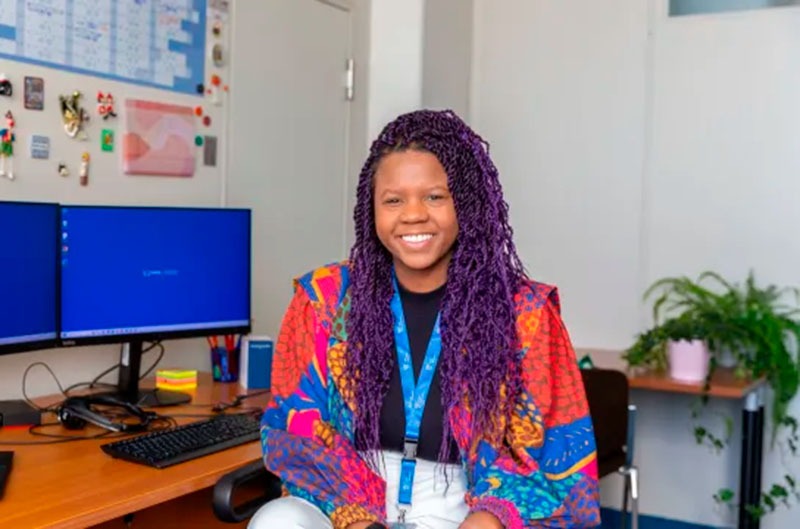
Growing up in São Gonçalo, Brazil, Dandara Araujo Da Silva experienced frequent power outages during the early XXI century. The lack of reliable electricity in her hometown sparked a lifelong ambition to transform the global energy sector. Da Silva realized quickly that people needed stable power for basic human development.
Today, she drives innovation as an Associate Nuclear Engineer at the International Atomic Energy Agency. Da Silva researches small modular reactors and microreactors to help developing nations secure consistent electricity. She focuses on different approaches to reactivity control and instrumentation systems.
Sara Kouchehbagh originally documented this journey for the International Atomic Energy Agency in early 2026. The profile highlights how Da Silva overcame immense financial barriers to engineer low-carbon power sources. Da Silva notes that the Global South requires large-scale solutions because renewable options such as solar and wind cannot meet demand on their own.
Overcoming Educational Barriers
Da Silva pursued her dreams with relentless determination. Financial challenges threatened her progress early on. However, her parents supported her enrollment in a technical high school. She spent countless hours at the local public library. She read university-level essays on calculus and physics. Her hard work eventually paid off.
The Federal University of Rio de Janeiro accepted her into its nuclear engineering program. She supported her studies by working as a calculus teaching assistant. This job required a grueling four-hour daily commute. Her dedication earned her the Junior Working Women for the Fem’Energia Award. This award promotes female careers in the European nuclear industry.
Mastering New Systems in France
In 2016, Da Silva applied to study abroad in France. France represents a global leader in atomic energy. The country operates 57 nuclear reactors. These reactors generate nearly 70% of French electricity. Da Silva initially faced a major obstacle. She did not speak French, spending months teaching herself the language. She finally met the strict linguistic requirements.
The National Institute of Applied Sciences of Toulouse admitted her. She pursued a master’s degree in mechanical systems engineering there. This program gave her a broader perspective on complex frameworks. She learned to evaluate industrialization, commercialization, and long-term deployment strategies.
Shaping the Future of Nuclear Power
Da Silva recognizes how nuclear engineering blends multiple scientific disciplines. The field combines physics, chemistry, biology, and sociology. Framatome offered her a position while she was studying. This French company boasts over 65 years of industry experience. She designed and maintained nuclear power plants around the world.
Eventually, Da Silva transitioned her career to the International Atomic Energy Agency. She redefines her life constantly to achieve her ultimate goals. She draws immense strength from her mother and grandmothers. These women refused the limited roles society dictated for them. Da Silva ignored her personal doubts to forge a successful path. Now, she helps the world embrace clean, resilient energy.
More news: Funds for Critical Minerals and Materials Accelerator
More: IAEA
