


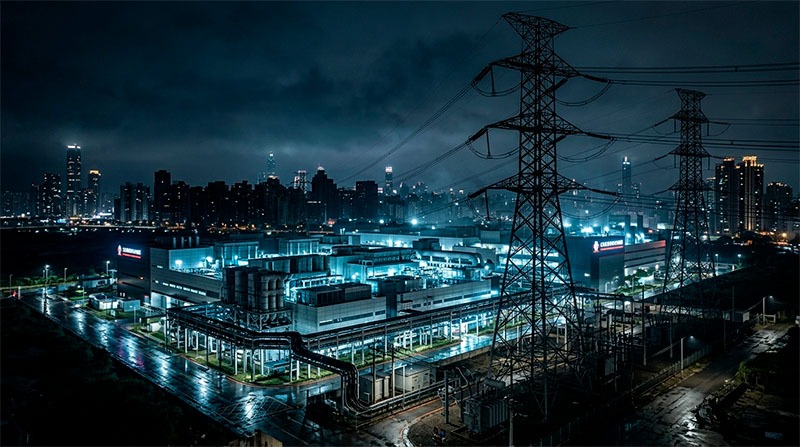
theThe rapid expansion of artificial intelligence hardware faces a severe and immediate bottleneck. Global technology giants design sophisticated chips, and end consumers provide relentless market demand. However, the physical manufacturing of these components relies heavily on two specific nations. Taiwan and South Korea produce the vast majority of the world’s advanced semiconductors. Now, the local power grids in these countries struggle to meet the surging electricity demands of these massive fabrication plants.
This energy crunch transforms a regional infrastructure issue into a global vulnerability for artificial intelligence deployment. Taiwan leads the world in advanced logic chip manufacturing and complex packaging techniques. Meanwhile, South Korea dominates the production of high-bandwidth memory and dynamic random-access memory. These components act as the foundational building blocks for modern artificial intelligence accelerators. A physical disruption in these Asian factories instantly halts technological progress everywhere.
The defining challenge of the XXI century technology economy might not be computing power, but actual electrical power. Geopolitical instability in the Middle East threatens the imported fossil fuels that power these Asian manufacturing hubs. A sudden disruption in liquefied natural gas supplies could trigger cascading failures across the technology sector. Semiconductor factories require continuous, high-quality electricity to function properly. The global technology industry must acknowledge this looming physical constraint.
A Highly Concentrated Hardware Market
The global technology industry relies on a dangerously narrow set of suppliers. Taiwan and South Korea control the critical production chokepoints. In this sense, the Taiwan Semiconductor Manufacturing Company, operating as TSMC, held a massive 70% share of the foundry market in 2025. Taiwan utterly dominates the most advanced manufacturing nodes. Advanced packaging capacity remains a severe bottleneck for artificial intelligence accelerators. South Korea plays an equally vital role in the memory sector. Samsung and SK Hynix combined to capture 68% of memory revenue at the end of 2025.
SK Hynix alone controlled 56% of the high-bandwidth memory market. High-bandwidth memory serves as a central enabling technology for modern systems. The world cannot simply substitute this specialized production capacity. These two nations also house a massive portion of physical infrastructure. South Korea held 24% of global 300mm wafer fabrication capacity in 2025. Taiwan followed closely with a 21% share of this critical capacity. This intense geographical concentration amplifies the consequences of any local grid failure.
Availability Outweighs the Price of Power
Critics often point to rising electricity costs as a major threat to chipmakers. The actual financial data tells a very different story. Both Taiwan and South Korea absorbed massive electricity tariff increases recently. Rates jumped between 60% and 70% since 2021. Yet, these massive price hikes did not destroy semiconductor profitability. TSMC reported a 56.1% gross margin and a 45.7% operating margin in 2024. Electricity costs represent a highly manageable expense for these profitable companies. Every $10 per megawatt-hour increase adds roughly $255 million to the annual bill for TSMC.
This remains a tiny fraction of its $117 billion revenue base in 2025. Samsung faces a remarkably similar financial dynamic. A $10 rate increase costs Samsung an extra $270 million annually. The company easily absorbs this against its $248 billion revenue in 2025. The true operational threat involves power availability, not power pricing. Fabrication plants require absolute electrical stability to function. Brief voltage dips ruin delicate silicon wafers instantly. Semiconductor margins easily absorb higher utility bills. However, the business model cannot survive a complete power outage.
Taiwan Faces Severe Structural Vulnerabilities
Taiwan operates its power grid under immense physical and policy constraints. The government actively phased out nuclear power over the past decade. This policy reduced low-carbon baseload capacity and increased reliance on fossil fuels. Thermal generation dominated the island’s power supply throughout 2024. Nuclear energy accounted for a remarkably small fraction of the overall mix. This structural shift makes Taiwan highly vulnerable to fuel supply shocks. The island’s reserve margin hovered at a dangerously low 6% during peak demand in 2025.
This figure falls far below the government’s official 15% target. Taiwan heavily depends on imported liquefied natural gas. This fuel serves as the critical balancing mechanism for the grid. Without it, Taiwan’s baseload capacity covers only 50% of its peak power demand. Geopolitical tensions in the Middle East threaten these vital gas delivery routes. A supply disruption during the summer peak could cause massive systemic failures. Grid operators rely heavily on demand-side response to manage these incredibly tight margins.
South Korea Maintains a Stronger Baseline
South Korea starts from a much stronger infrastructural position than Taiwan. The nation also imports the vast majority of its energy fuels. However, South Korea maintains a significantly more diversified power generation portfolio. Nuclear energy generated approximately 31% of the country’s electricity in 2024. Coal and gas represent large shares but do not dominate the grid completely. Grid operators utilize formal reserve planning to maintain systemic stability. The current regulatory framework targets a comfortable 20% reserve margin.
This buffer provides South Korea with greater operational headroom during peak demand periods. Peak demand reached a massive 102.3 gigawatts in August 2024. The grid handles this extreme load better due to the strong nuclear baseload. Still, South Korea cannot completely escape fuel importation risks. The nation lacks any cross-border power interconnections. Imported gas remains a crucial fuel for flexible generation at the margins. If a crisis blocked fuel imports, South Korea would still face tight operating conditions. South Korea shows more resilience, but neither country boasts total grid immunity.
Corporate Energy Appetites Continue to Surge
The sheer scale of semiconductor electricity consumption staggers the imagination. TSMC alone consumed 27.5 terawatt-hours of total energy in 2024. Purchased electricity accounted for roughly 93% of this massive total. This means the company used roughly 25.6 terawatt-hours of grid electricity. The corporation single-handedly consumes approximately 9% of Taiwan’s total electricity. South Korean technology giants display similar massive energy appetites. Samsung Electronics reported an astonishing group electricity use of 32.1 terawatt-hours in 2024. Its semiconductor division accounted for 29.0 terawatt-hours of that massive total.
SK Hynix consumed 12.6 terawatt-hours of electricity during the exact same period. Artificial intelligence chips require significantly more power to manufacture than legacy chips. Advanced manufacturing nodes involve far more complex process steps. Extreme ultraviolet lithography tools demand massive amounts of constant electricity. Manufacturers actively attempt to cut peak tool power by 44% to manage this burden. Companies optimize energy use because raw consumption levels now represent a strategic vulnerability.
Infrastructure Redundancy and Emergency Prioritization
Semiconductor companies do not act as passive consumers on the public grid. They invest heavily in infrastructure redundancy to protect their fragile operations. Fabrication plants utilize massive uninterruptible power supply systems. These battery systems cover critical operational loads during short voltage dips. Companies also install on-site backup generators to mitigate longer grid disruptions. These robust measures successfully prevented major factory damage during Taiwan’s massive 2017 blackouts. South Korea also avoided major nationwide blackouts over the past decade.
Grid operators in both countries treat semiconductor manufacturing as a top strategic priority. Neither nation publishes a formal public document placing chipmakers at the front of the line. However, their load-shedding frameworks clearly prioritize these industrial giants during a crisis. Grid operators curtail power to residential areas and less critical industries first. Governments recognize that protecting these factories preserves the global technology economy. Protecting massive fabrication plants during a shortage pushes immense stress onto the rest of the grid.
The Limits of Alternative Power Substitution
Policymakers desperately explore options to increase emergency power generation capacity. Both nations maintain older power plants that could theoretically offset fuel shortages. Taiwan currently considers restarting several dormant nuclear facilities. Restoring specific older plants could add 2 gigawatts to 4 gigawatts of power. Increasing the utilization of older coal plants might yield another 2 gigawatts to 4 gigawatts. Altogether, Taiwan might mobilize between 4 gigawatts and 8 gigawatts of substitution capacity. This additional power would still fail to replace the flexibility of gas during peak demand.
South Korea commands significantly more substitution capacity. Extending the operational life of nuclear plants could provide a 3-gigawatt to 5-gigawatt uplift. South Korea also operates a massive national coal fleet. Delaying coal plant retirements could provide an additional 3 gigawatts to 6 gigawatts. South Korea could theoretically offset between 6 gigawatts and 10 gigawatts during an emergency. This flexibility further insulates South Korea from sudden supply chain shocks. Taiwan faces a much higher immediate risk of a catastrophic grid failure.
Redefining Global Investment Risks
Financial markets must recalibrate their models to account for physical energy constraints. Analysts traditionally focused on chip design superiority and consumer demand metrics. Now, the ability of a power grid to reliably deliver electricity dictates market winners. Investors face a new paradigm where infrastructural resilience outweighs simple financial cost metrics. A blackout poses a far greater threat than a simple hike in utility rates. Outages destroy delicate inventory and delay critical hardware shipments to global technology giants.
The artificial intelligence sector commands unprecedented capital investment worldwide today. However, this entire financial ecosystem rests upon highly fragile Asian utility grids. Governments and corporations must collaborate to rapidly harden these vital power networks. The future of global computing depends entirely on local grid stability in Asia. Energy security now functions as the ultimate industrial policy. Companies that secure reliable power will dominate the next decade of technological advancement.
More news: Natural Gas Pipeline from Pennsylvania to New York City and Long Island
More: UBS
