


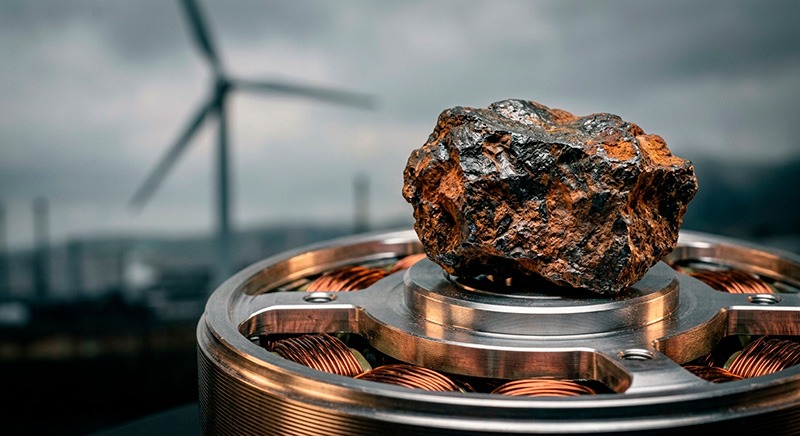
Rare earth elements drive the modern economy. These 17 obscure metals power electric vehicles, wind turbines, artificial intelligence data centers, and advanced military systems. A recent report from the International Energy Agency highlights their critical role in global energy and economic security. The global market value for these elements currently stands at $6.4 billion. Experts consider them indispensable for modern industrial progress and technological innovation across multiple sectors.
Despite this relatively modest market size, the massive economic impact of rare earth elements extends much further into the global economy. The International Energy Agency estimates that a major disruption in the global supply chain could put $6.5 trillion of downstream manufacturing at severe risk. This stark financial figure underscores the heavy reliance of modern industries on a few highly concentrated supply sources. Global markets remain exceptionally vulnerable to sudden trade shifts and geopolitical tensions.
China currently dominates the global supply chain for rare earth elements. The Asian nation extracts roughly 60% of the world’s rare earth ores and refines 91% of the global output. Chinese facilities also manufacture 94% of the high-performance neodymium-iron-boron magnets that power modern electric motors. This profound market concentration poses severe risks to global economic stability. Western governments face an urgent need to diversify their critical material sources before disruptions occur.
Export Controls Spark Global Alarm
In 2025, China introduced strict export controls on seven heavy rare earth elements. These elements included critical metals like dysprosium and terbium. The Chinese government later expanded these restrictions in October 2025. This expansion covered additional elements and processing technologies. It also required foreign companies to obtain specific licenses. These new licenses applied to internationally made products containing Chinese-sourced materials. Export volumes plummeted immediately following the sudden policy announcement.
Many automakers in the United States and Europe struggled to source permanent magnets. Factory managers consequently reduced their operational utilization rates. Some automotive companies temporarily shut down their production lines entirely. The International Energy Agency report details the massive potential fallout. The report states, “If these rare earth export controls were implemented in full, the economic value of downstream production at risk would reach USD 6.5 trillion per year for countries outside China.”
The United States and Europe face massive industrial exposure. Each region could suffer direct economic losses exceeding $1.5 trillion. The global automotive sector bears the greatest financial risk overall. It faces over $3 trillion in potential direct losses outside China. Other vulnerable industries include electronics, commercial aviation, and national defense. F-35 fighter jets, nuclear submarines, and surveillance drones all require heavy rare earth elements. Supply shortages directly threaten global national security capabilities.
The Push for Supply Chain Diversification
Global demand for magnet rare earths will soar throughout the coming decade. Demand outside China will jump by 50% by 2035. Rapid electric vehicle deployment drives this massive industrial growth. Current production capacities outside Chinese borders fall drastically short. Existing and planned projects will cover only a fraction of future needs. They will supply 50% of mining demand and 25% of refining demand by 2035.
They will meet less than 20% of the projected demand for finished magnets. Meeting projected global demand requires aggressive infrastructural expansion. Mining companies must double extraction capacity and quadruple refining capacity. Manufacturers must expand magnet production capacity by a factor of six. Several countries plan to develop new mining projects shortly. Australia and the United States lead these critical extraction efforts. Brazil, India, and Tanzania also hold promising mineral reserves. However, mining solves only one part of the complex equation.
Refining and magnet manufacturing present the true industrial bottlenecks. Processing rare earth elements requires highly specialized industrial equipment. It demands complex chemical processes and strict environmental safeguards. Only a few industrial-scale refineries operate outside China today. Facilities in Malaysia, the United States, and Estonia process limited volumes. The gap between upstream mining and downstream manufacturing remains dangerously wide. Many regions will still depend on China for final material processing.
Financial Hurdles and Investment Needs
Building a secure supply chain requires massive financial capital. The International Energy Agency estimates the required investment at $60 billion over the next decade. Refining facilities demand nearly half of this total funding. Magnet manufacturing claims roughly one-third of the total investment. Project developers in diversified regions face steep financial challenges. These infrastructure projects struggle with higher capital and operating costs. Smaller production scales and expensive input prices hurt their economic viability. Complex permitting processes cause lengthy developmental delays. Early-stage financing presents a massive obstacle for mining companies. Developers must commit significant capital before securing revenue guarantees.
Conversely, downstream customers demand proven technical feasibility from suppliers. Buyers want firm guarantees before signing long-term purchasing agreements. This dynamic creates a severe structural mismatch in the market. By contrast, Chinese producers enjoy massive structural market advantages. They utilize established industrial ecosystems and shared national infrastructure. They access low-cost energy and heavily subsidized raw materials. Large domestic markets provide robust and stable demand signals.
Price volatility further discourages private investment outside China. Rare earth markets lack transparent benchmark pricing mechanisms completely. The global market relies heavily on opaque, over-the-counter transactions. This opacity makes cash-flow projections extremely difficult for analysts. It raises the cost of capital for new market entrants. Governments must step in to close this massive funding gap. The International Energy Agency report notes, “Public support mechanisms – including grants, loan guarantees and support for shared testing facilities – can accelerate commercialization.”
Environmental Costs and Technological Innovation
Extracting and processing rare-earth elements harm the natural environment. The mining process generates massive amounts of toxic industrial waste. Rare-earth ores frequently co-occur with radioactive elements such as thorium. Improperly managed tailings contaminate water bodies and surrounding soil ecosystems. In situ leaching dominates operations in southern China and Myanmar. Mining workers inject harsh chemical reagents directly into the earth. This method extracts valuable ions but severely pollutes groundwater reserves.
Processing plants emit acid gases and toxic solvent vapors. Western nations enforce stricter environmental regulations on mining operators. These regulations increase operational costs but protect local communities. Technological innovation offers solutions to balance economics and environmental sustainability. Mining companies explore bioleaching and novel separation technologies. Bioleaching uses microorganisms to extract metals from raw ores. This biological method reduces the need for aggressive chemical reagents. Other companies develop continuous solvent extraction processes for refineries.
These innovations aim to reduce reagent consumption and energy use. Innovation also targets the demand side of the supply equation. Mechanical engineers work to reduce the heavy rare-earth content. Automakers improve motor cooling designs to maintain performance with fewer materials. Some companies attempt to eliminate rare earth elements entirely. They develop iron nitride magnets or alternative electromagnetic motor designs. These substitutes currently face performance limitations in high-stress applications. Continued research and development funding remains absolutely vital for success.
The Promise of Recycling and Circularity
Recycling presents a massive opportunity to secure global supply chains. Secondary sources could reduce primary mining requirements by 35% by 2050. Manufacturing scrap currently provides the majority of secondary material supply. However, this scrap largely originates within Chinese national borders. End-of-life products offer a more geographically diverse material source. Electric vehicle motors and wind turbines contain large, recoverable magnets. These green technologies boast relatively long operational lifespans.
As early models retire, they will create a surge in recyclable materials. Europe holds a strong position to capitalize on this trend. By 2030, Europe will generate half of the global magnet scrap from wind turbines. European countries will also produce 25% of the global electric vehicle magnet scrap. Current recycling rates for electronic waste remain dismally low. Small magnet sizes and complex product designs hinder industrial extraction efforts. Disassembling consumer electronics proves economically unviable under current market conditions.
Targeted public policies must unlock this circular economy potential. Governments should mandate rare earth content disclosure in all new products. Product labeling improves material traceability and sorting efficiency. Policymakers must also harmonize extended producer responsibility schemes globally. According to the report, “De-risking investment in recycling infrastructure through grants, feedstock-access programs and recycled-content incentives is essential to scale emerging recyclers and technologies.” Financial incentives will encourage companies to build domestic recycling infrastructure.
Strategic Stockpiles and Global Cooperation
Nations cannot build secure supply chains in total isolation. Market diversification requires cross-border investments and technology-sharing agreements. Governments must form international partnerships to align upstream development with downstream demand. Short-term emergency preparedness demands immediate attention from global policymakers. Countries must establish strategic stockpiles to weather sudden supply shocks.
The United States, Japan, and Korea already maintain critical mineral reserves. The operating cost of a strategic stockpile remains surprisingly modest. Covering one year of exposed imports for countries outside China costs around $200 million annually. This investment pales in comparison to the multi-trillion-dollar economic risks. Governments should utilize contracts for difference to stabilize project revenues. These financial mechanisms set a fixed strike price for an operator’s output. If market prices fall below this threshold, the government pays the difference. This structure guarantees revenue stability and attracts private capital.
The International Energy Agency emphasizes the absolute need for comprehensive action. The report advises, “Efforts to nurture and expand downstream industries – such as EVs, new energy technologies and high-tech manufacturing – outside China can play a critical role.” Without robust downstream manufacturing, upstream mining projects face highly uncertain demand. The world stands at a critical juncture in the global energy transition. Securing rare earth elements dictates the future pace of global technological advancement. Comprehensive policy action ensures a resilient and diversified economic future.
More News: Defense Production Act to Overhaul Energy Infrastructure
More: IEA
